

SecurityInsight documentation · Verified against SecurityInsight 3.0.79 on Nov 9, 2026
Releases, rings and waves
How a new SecurityInsight release travels from the vendor to your install, how a release is watched once it is out, and what decides whether it may go further. The update itself is described in Updates and upgrades.
Rings
Every install belongs to one update ring. A release reaches the rings in order, never skipping one:
| Ring | Name | Who |
|---|---|---|
| 0 | Dev | The vendor’s own installs |
| 1 | Test | The vendor’s test installs |
| 2 | Design partners | Customers who take releases early and give feedback |
| 3 | Broad | Every other customer (the default) |
SecurityInsight decides which version goes to which ring; Invardia’s update platform relays it and signs, per ring, a manifest that names the release and its SHA-256. Your updater asks for the manifest of its own ring only, and refuses a manifest signed for another ring.
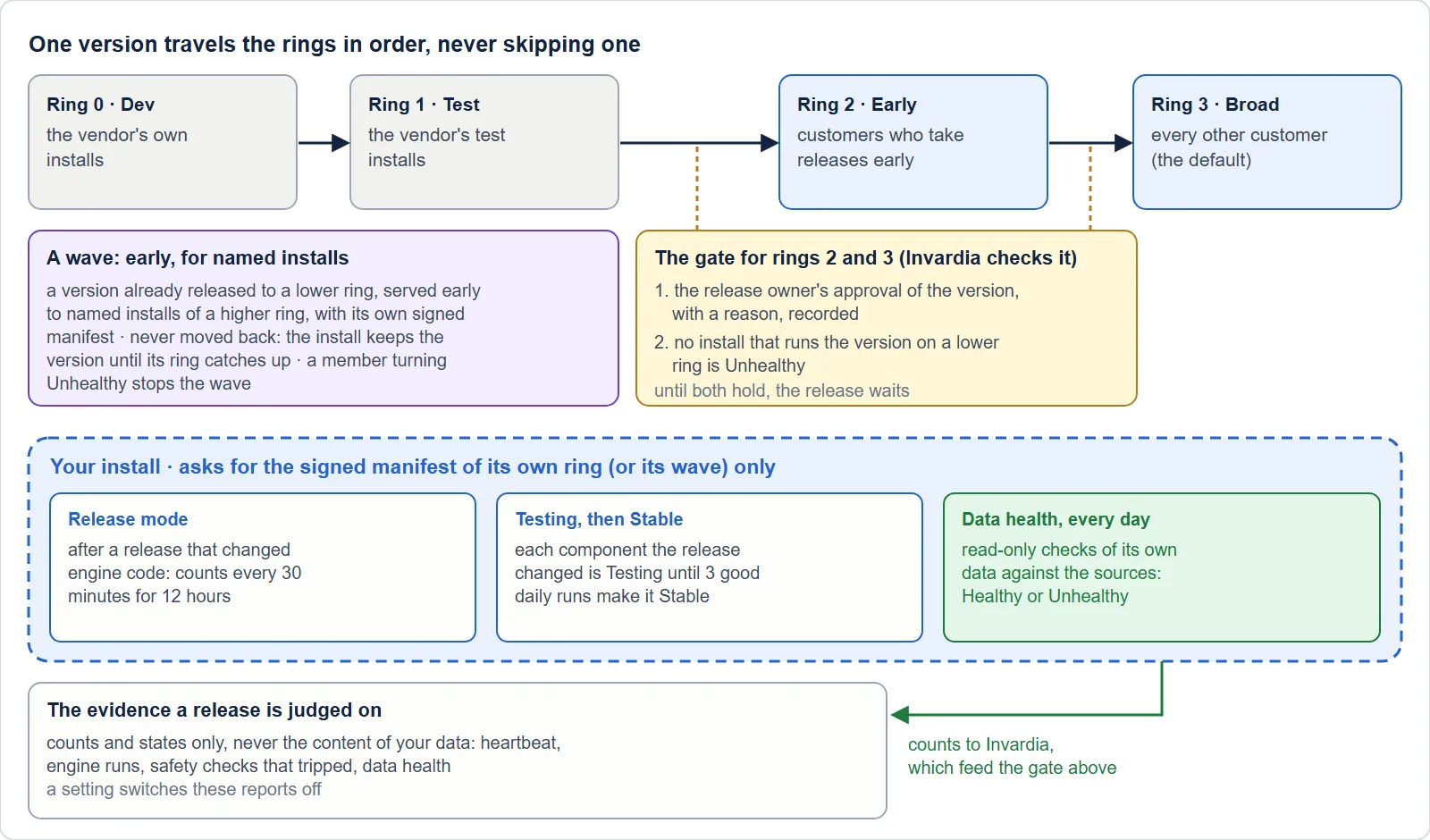
What a release must pass
| Gate | Rule |
|---|---|
| Ring 0 | Always allowed. |
| Ring 1 | Never held, but a release goes to ring 1 only after it has run cleanly on ring 0. |
| Rings 2 and 3 | Need the APPROVED state on the release, set only by the vendor’s release owner, with a reason, recorded. Invardia refuses a ring 2 or 3 release, or a wave, of a version without it. |
| The health gate | A version is not promoted to the next ring while an install that runs it turned Unhealthy after taking it (see Data health), or stopped reporting for 48 hours. Only the release owner overrides, with a reason. |
| Setup-only releases | A release that changes only setup or install scripts, and no engine code, needs no APPROVED and goes to rings 1 and 2 as before, so a fix for a customer waiting on an install is not delayed. It is shown and logged on the release. |
Withdrawing APPROVED stops further promotion. It never rolls an install back.
Waves: an early release for chosen installs
A wave lets a few named installs take a version early, before the rest of their ring, without moving them to another ring:
- The vendor names the installs of a wave. A wave can only serve a version already released to a lower ring.
- A member’s updater receives the wave’s signed manifest instead of its ring’s. Nothing else changes.
- The header shows
Ring 2 - Pre-release (<wave name>), and the heartbeat to Invardia says the same. - Never moved back. Leaving or stopping a wave never downgrades an install: it keeps its version until its ring catches up. The wave ends when the ring gets that version.
- A member that turns Unhealthy, or stops reporting, after taking the wave’s version stops the wave. There is no automatic rollback.
Release mode: watching a new release closely
After a release that changed engine code, every install that takes it reports more often for a while:
| How often | Every 30 minutes, for 12 hours from the update |
| What | Counts only, on the identified heartbeat: users, guests, devices, the guard mode, the wave and the release-mode period |
| At the same time | Every numbered safety check is twice as strict for 24 hours. See Guards and guard modes. |
Components: Testing and Stable
A release names the parts of SecurityInsight it changed. Each part is one component:
- the collection of each source (identity, endpoint, Azure, public IP, the privilege-tier classifier, asset properties);
- correlation (the CI build);
- Risk Analysis, per report;
- data out, per channel (CMDB, vulnerabilities, mail, SQL, outputs, tagging).
A changed component is Testing at your install until it has had 3 good daily runs with no further code change; then it is Stable. A failed run starts the count again. Settings > Updates shows how many components are testing and which. A change to shared core code makes every component Testing.
The evidence a release is judged on
- Every install checks itself, every day, on every ring, with its own read-only engine identity, and sends counts and verdicts: its data health, the safety checks that tripped since the release compared with before, and the progress of long runs. This is the main evidence.
- A spot check, only on rings 0-2 and only in release mode. Invardia’s support reads, read only, through the
Invardia Support app, and only where you have that app enabled. Each read is recorded before it runs with the reason
release review SecurityInsight <version>and shown in your activity log at Invardia. Only counts and verdicts are kept, never names, ids or values. Your environment’s switch “release spot checks allowed” (on by default for rings 0-2) turns it off without leaving the ring. A spot check never holds a release by itself. - The release review. Invardia’s support writes its findings on the release, SecurityInsight answers, and a proposal (approve, wait or stop, with the reason) goes to the release owner, who decides.
What you control
| You want to … | How |
|---|---|
| Take releases early | Ask to join ring 2 (Design partners) or a wave |
| Take releases late | Stay on ring 3 (Broad), the default |
| Stop spot checks | Switch “release spot checks allowed” off for your environment at Invardia |
| Stop updates for a while | Switch Pro updates from Invardia off in Settings |
| Hold a release that needs a manual step | It is held by itself until you accept it. See Updates and upgrades. |
Verified against SecurityInsight 3.0.79 on Nov 9, 2026Download PDF