



Every feature, edition by edition
Start free with Community. Pro adds everything below it - and you can try any Pro edition free for 60 days.
See who can do what
Every path in your delegation model on one board: who holds what, through which nested groups, and what a role really allows - answered in seconds, with the granting path shown next to the answer.
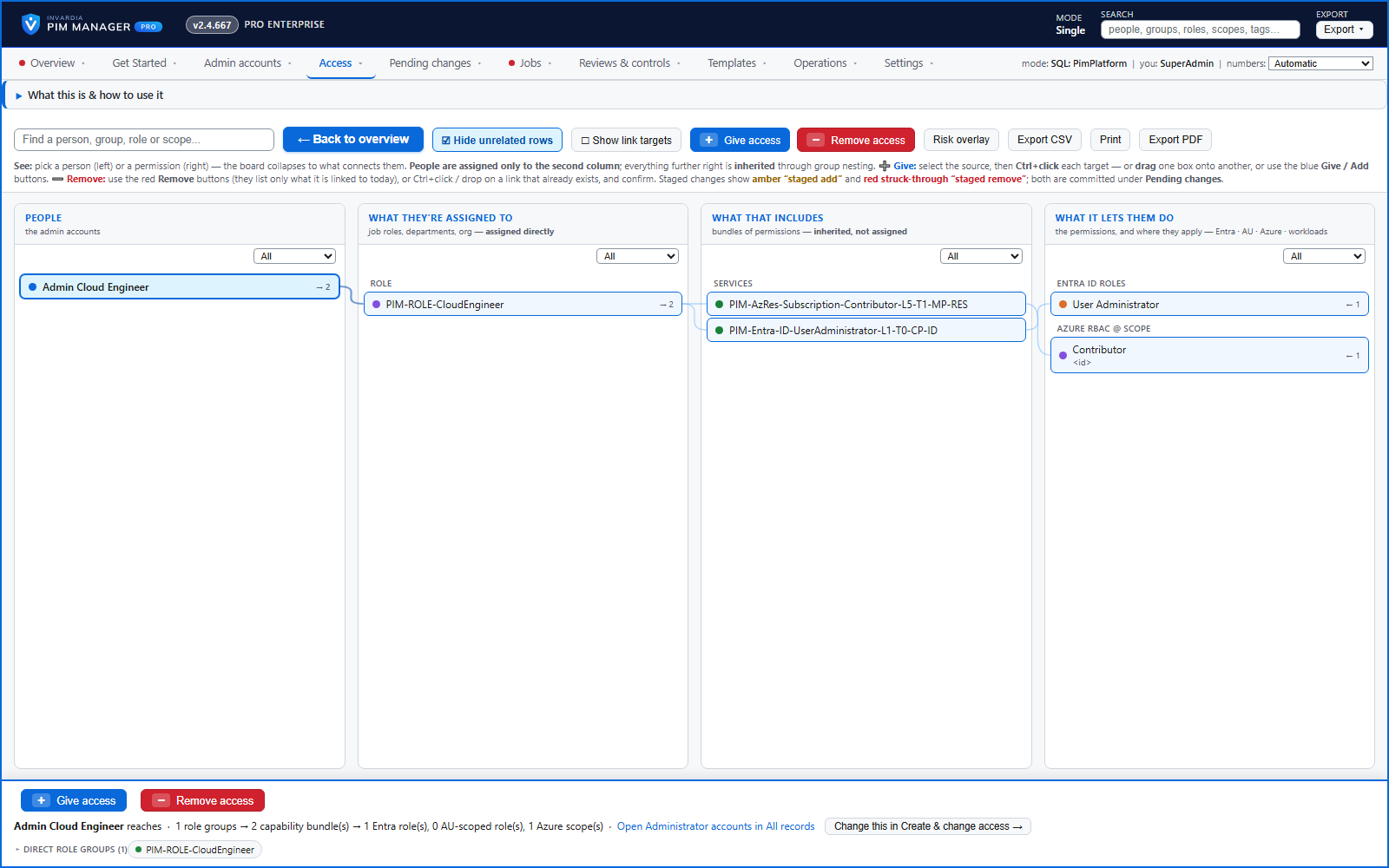
Access map: your delegation model on one board
Pick a person or a permission and see every path in your delegation model - people, their groups, what those groups include and the roles and scopes they grant.
How it works →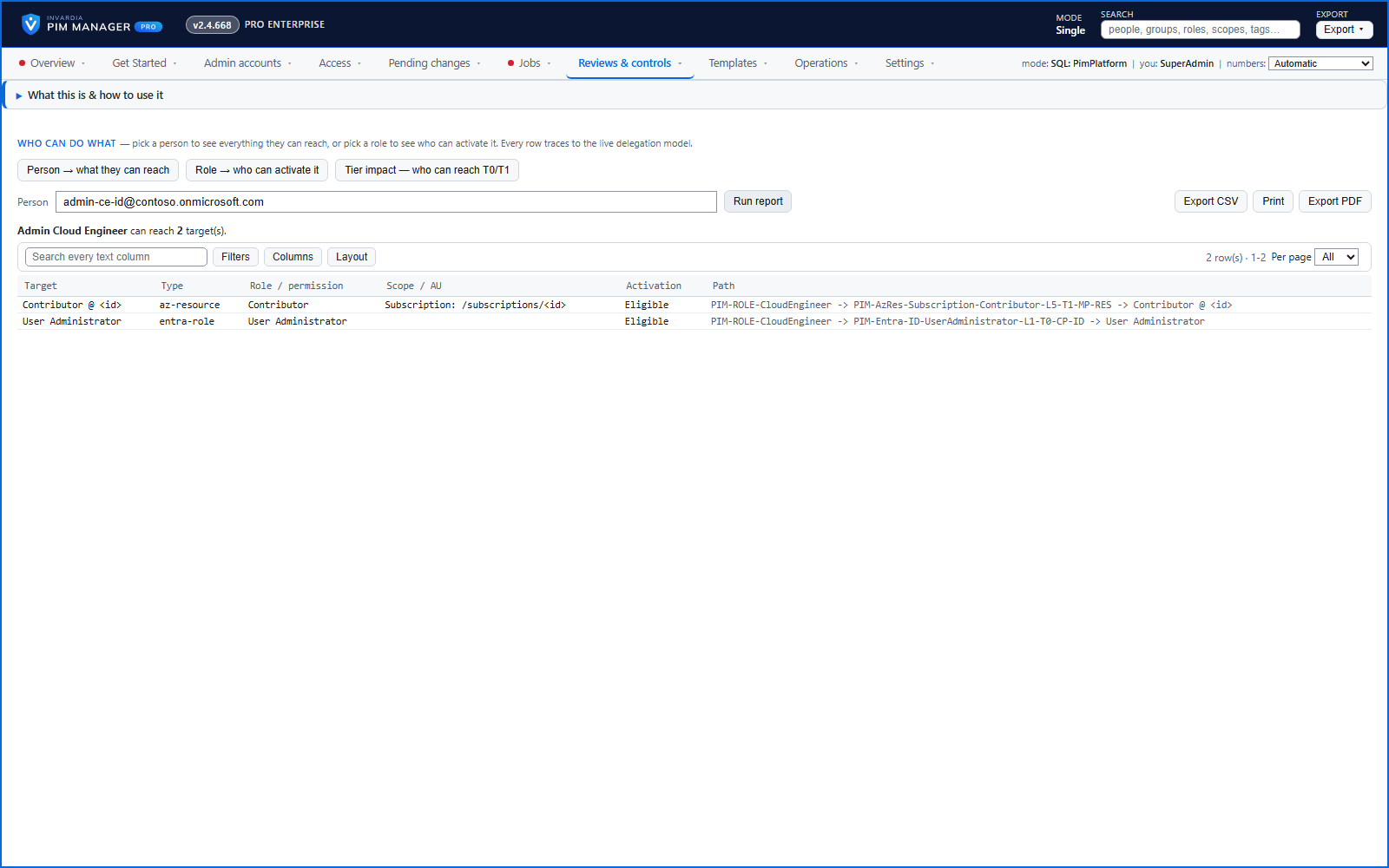
Who can do what - and who can activate this role
Pick a person to see the targets they can reach, or pick a role to see who can activate it - each with the exact path that grants it.
How it works →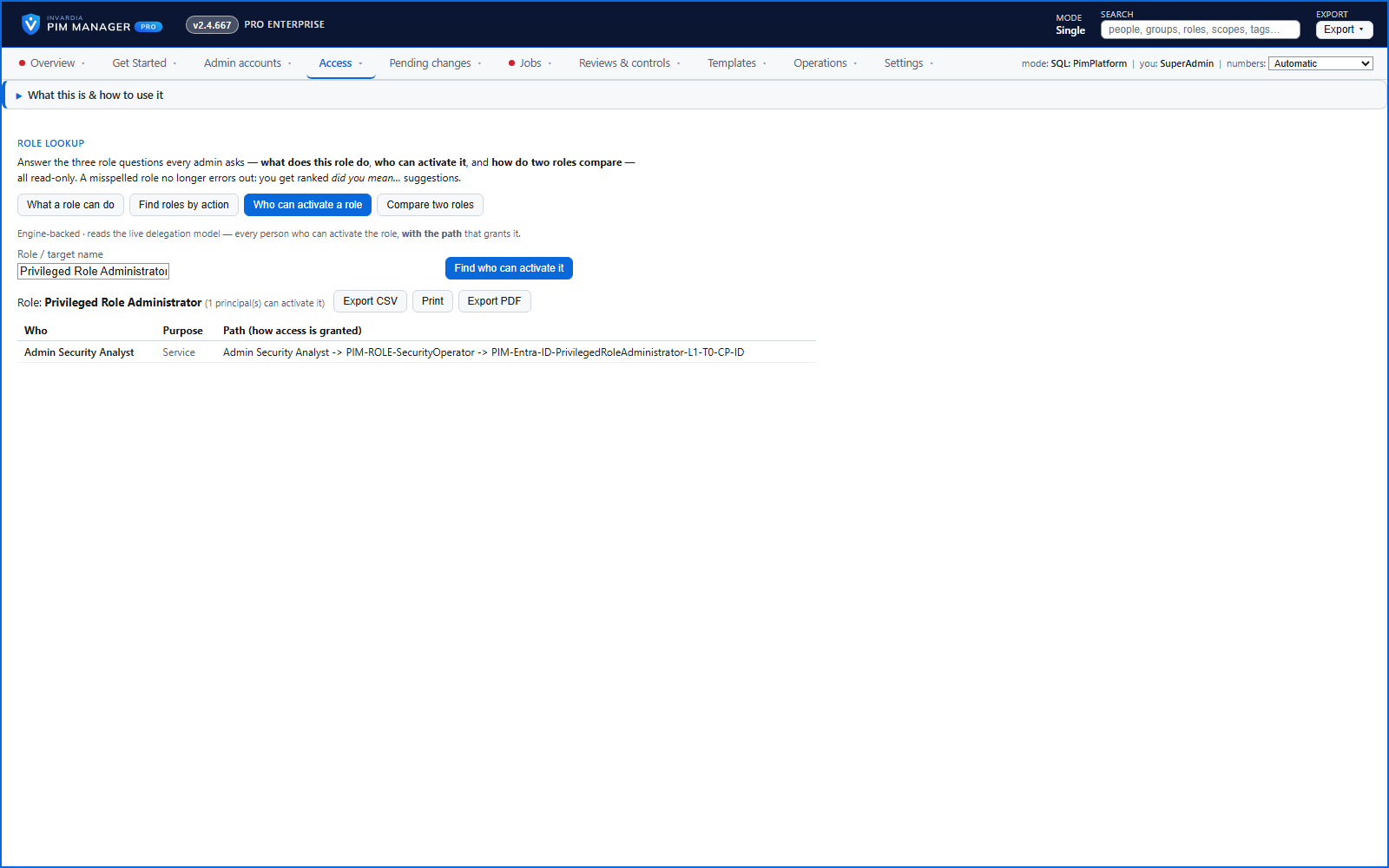
Look up a role: find the least-privileged role for the job
See what an Entra ID role can do in plain words, find the roles that grant an action ranked least-privileged first, see who can activate a role, or compare two roles.
How it works →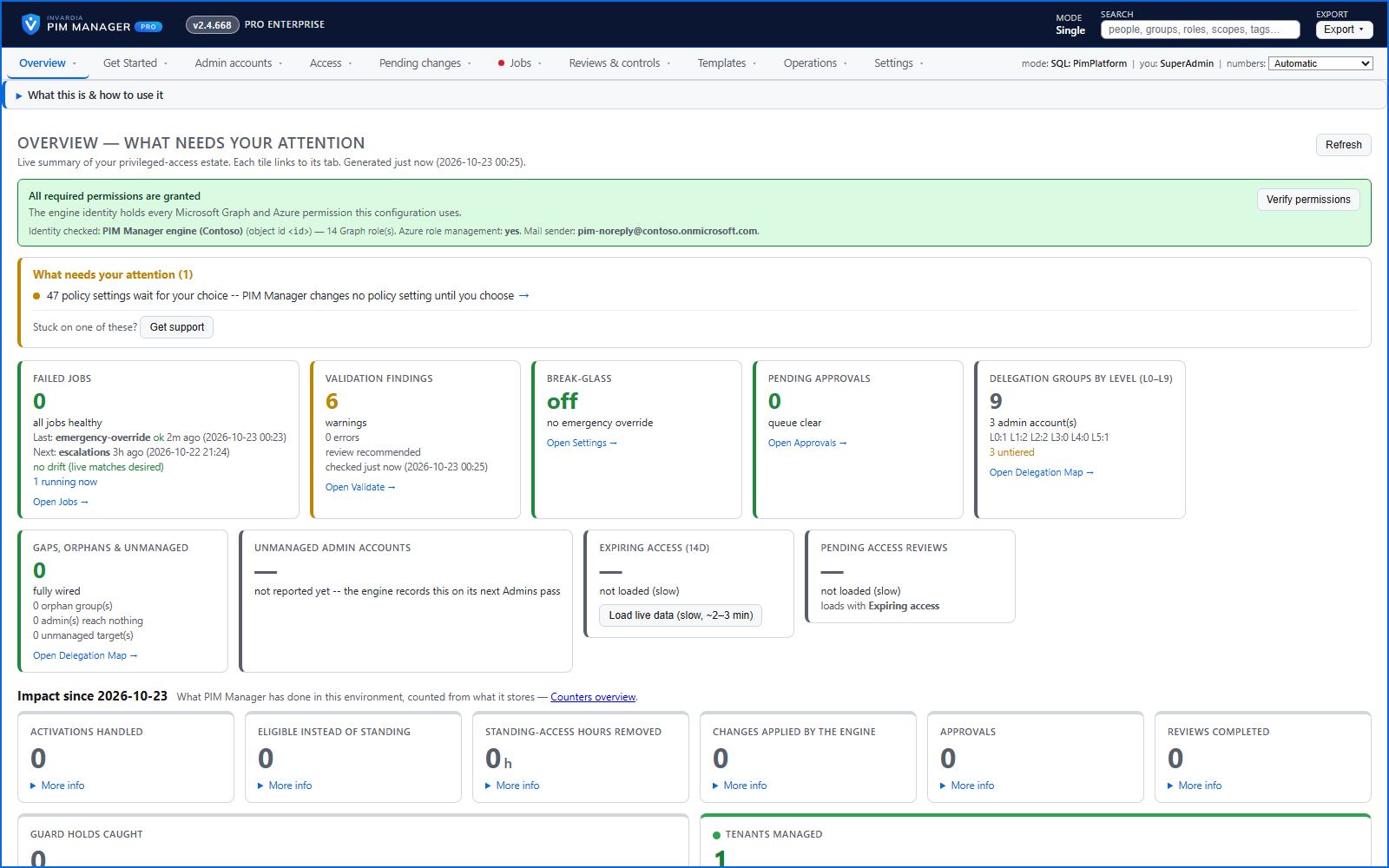
Home: what needs your attention, at a glance
Red, amber and green tiles for engine health, validation findings, break-glass use, delegation by level, gaps and expiring access - each opens the page that owns it.
How it works →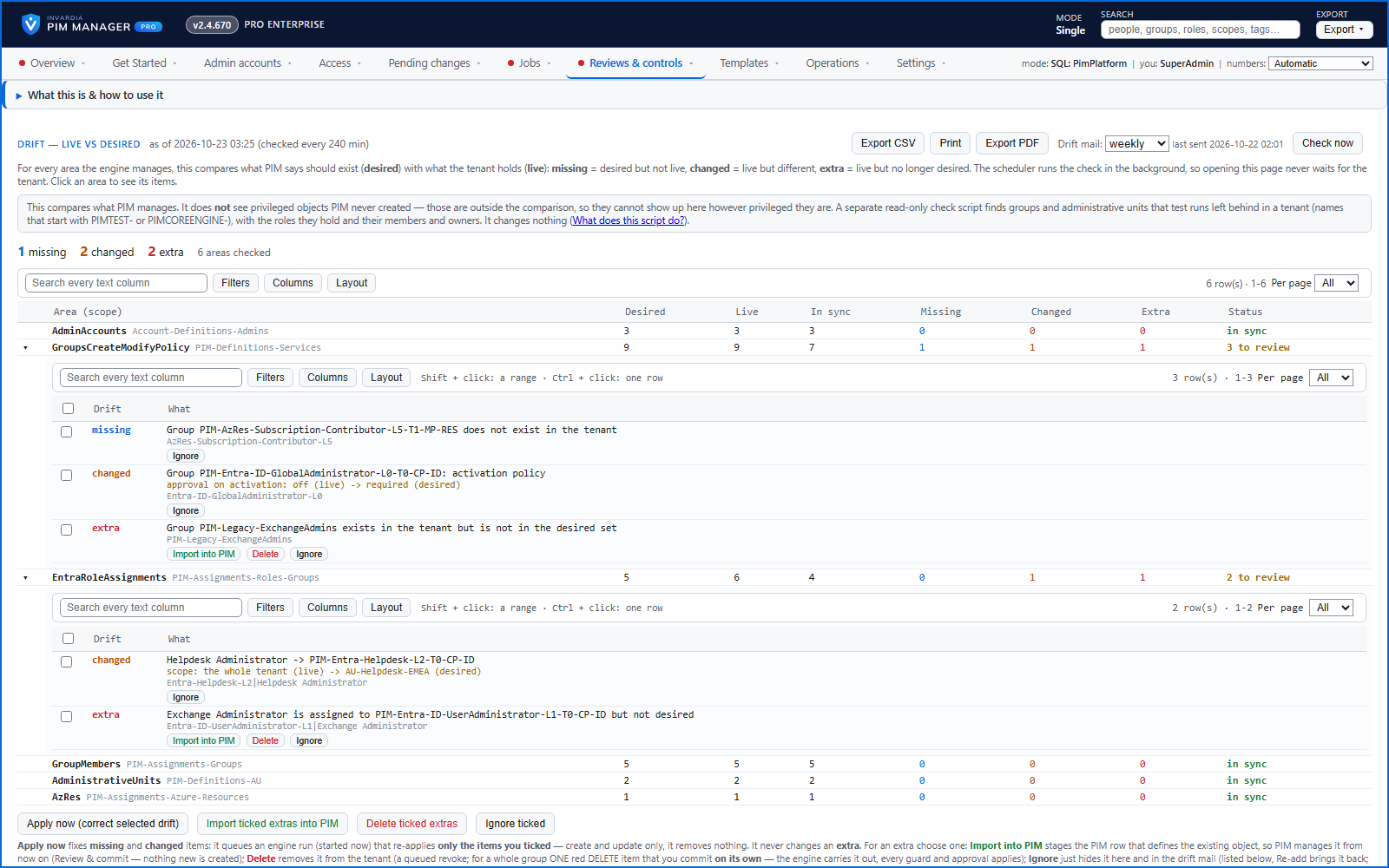
Drift: live versus desired, with a decision for each difference
See what is missing, what was changed and what is extra in the tenant - and decide what happens to each item: Apply now, Import into PIM, Delete, Ignore or Re-add.
How it works →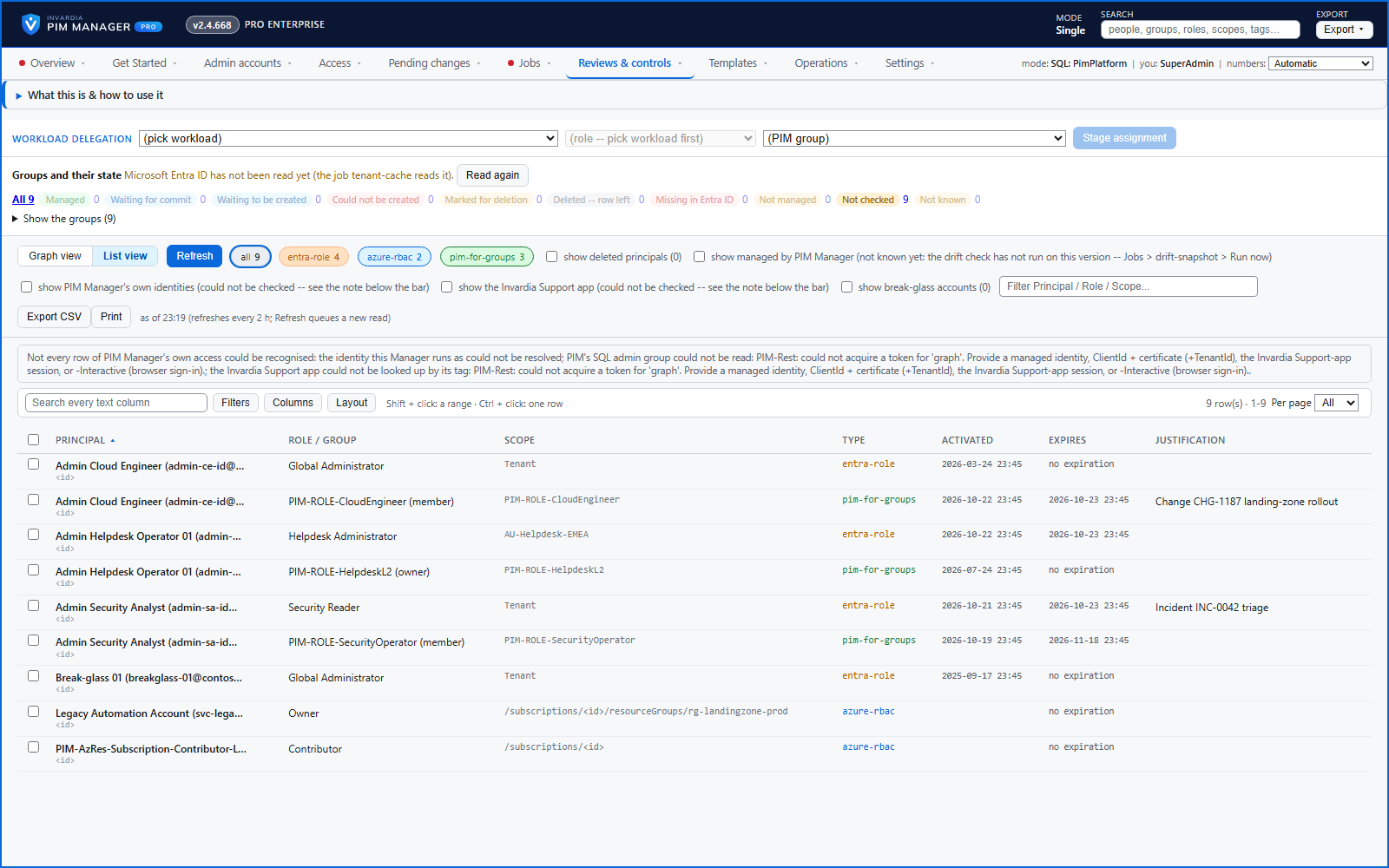
Delegation overview: the active privileged assignments right now
The active Entra ID role, Azure role and PIM for Groups assignments in your tenant in one view, opening at once from a stored snapshot.
How it works →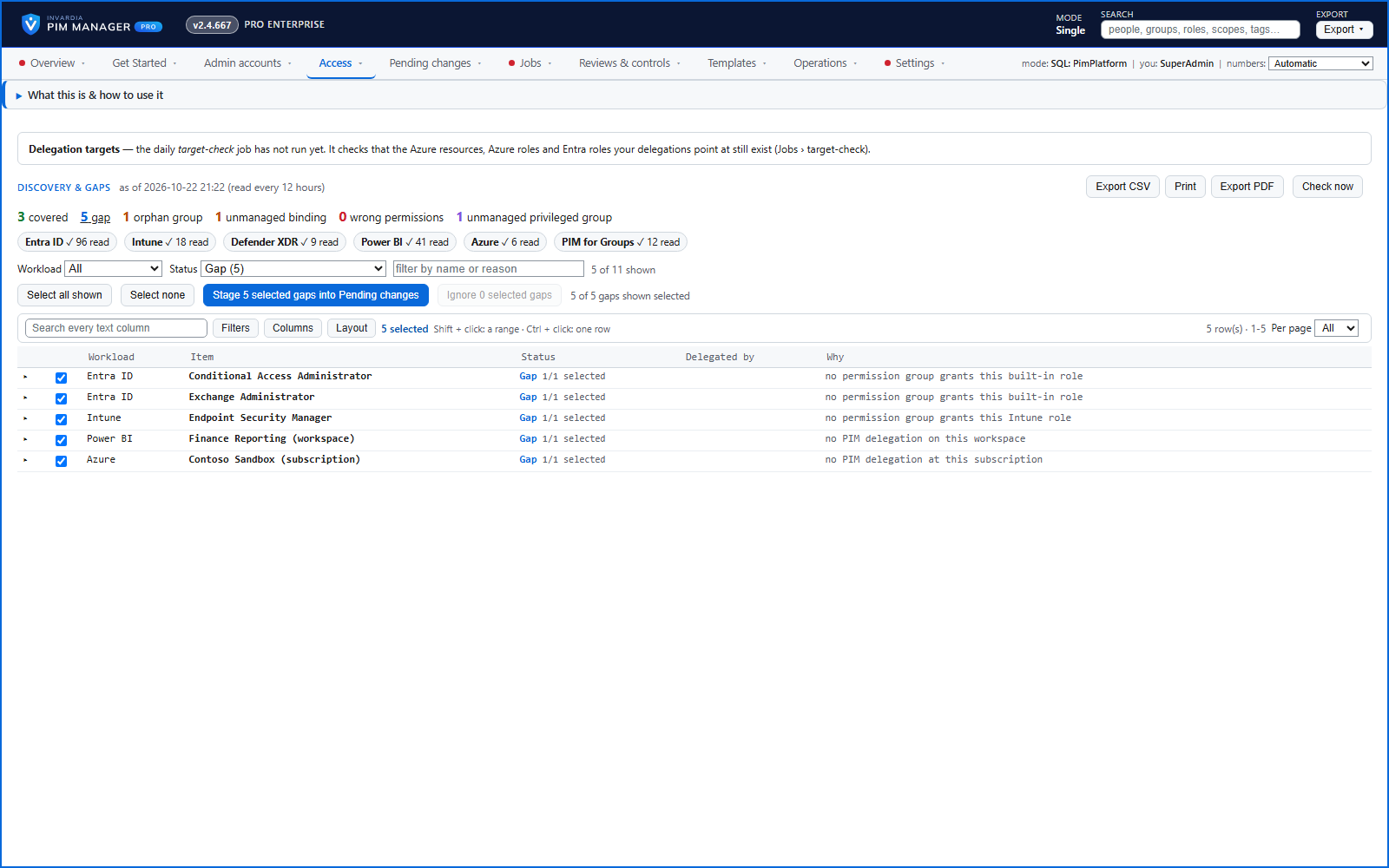
Discovery and gaps across your workloads
One page shows what is delegated through PIM Manager and what is not - across Entra ID, Intune, Defender XDR, Power BI, Azure and PIM for Groups - with ready proposals.
How it works →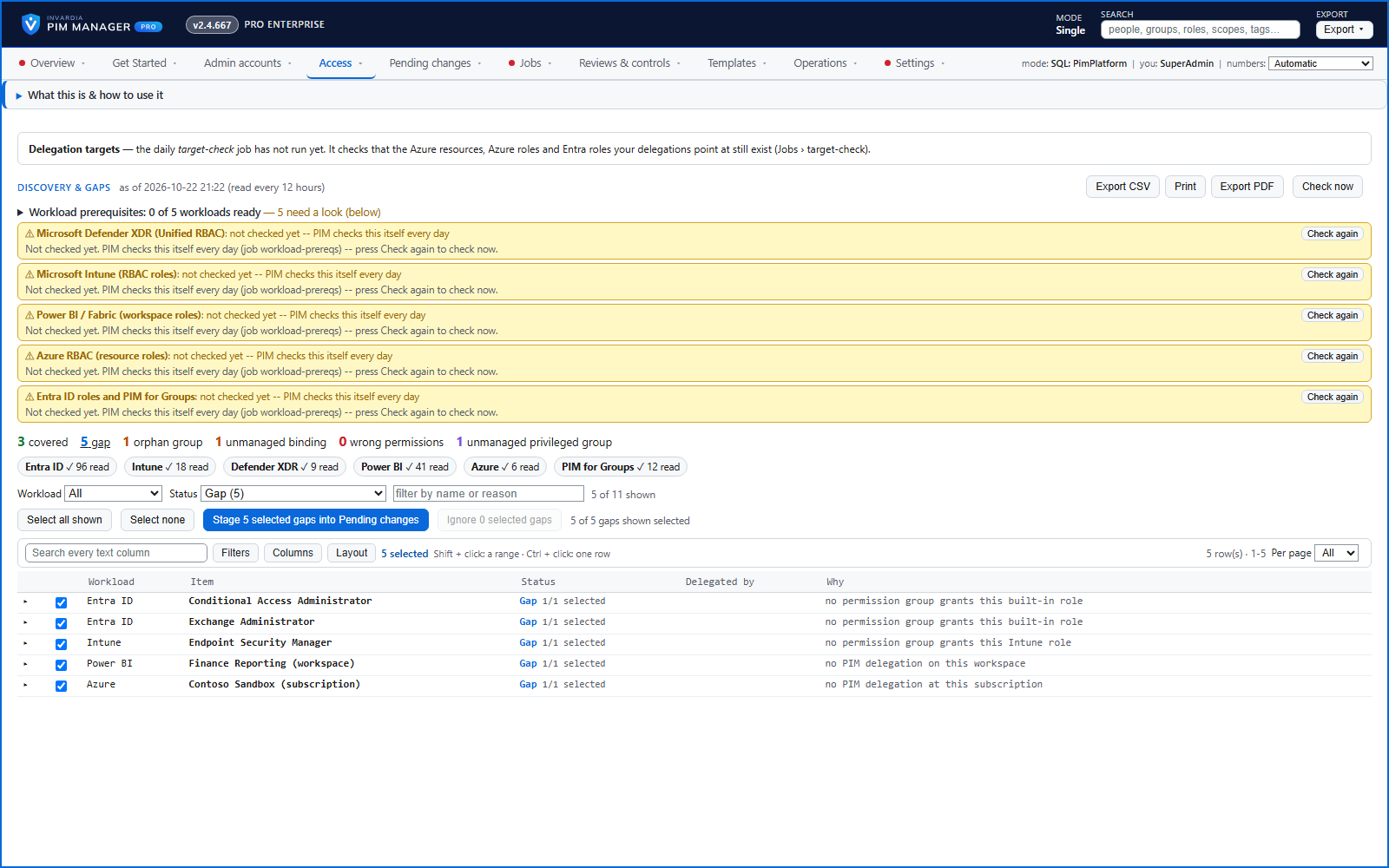
Discovery: new resources ready to delegate
New Azure subscriptions and management groups, Power BI workspaces, administrative units and new Entra ID, Intune and Defender XDR roles appear on Discovery and gaps - stage a proposal or ignore it.
How it works →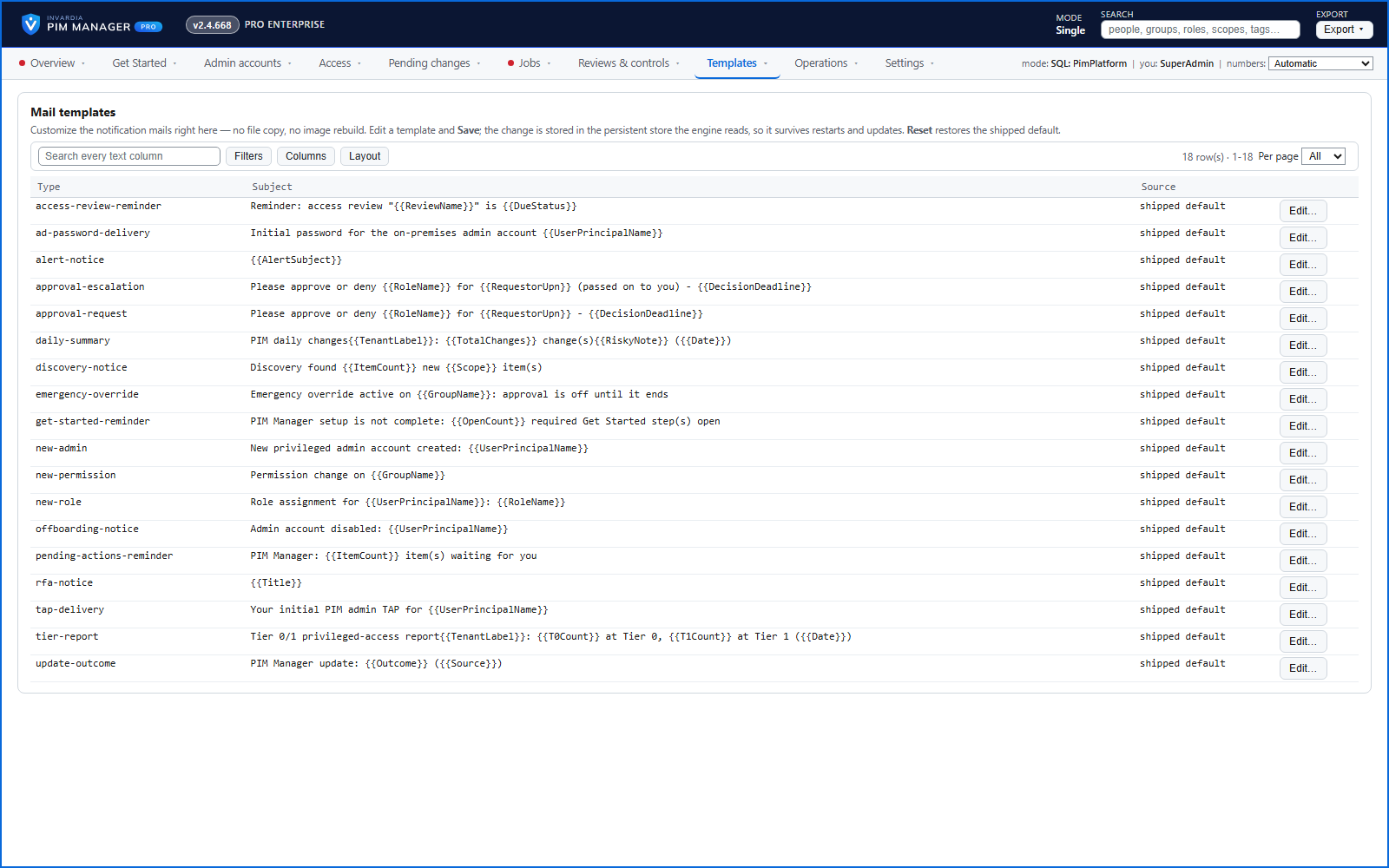
Alerts by mail and Teams
A failed run, drift, access expiring soon and break-glass use - by mail, to a Microsoft Teams channel or to another https webhook.
How it works →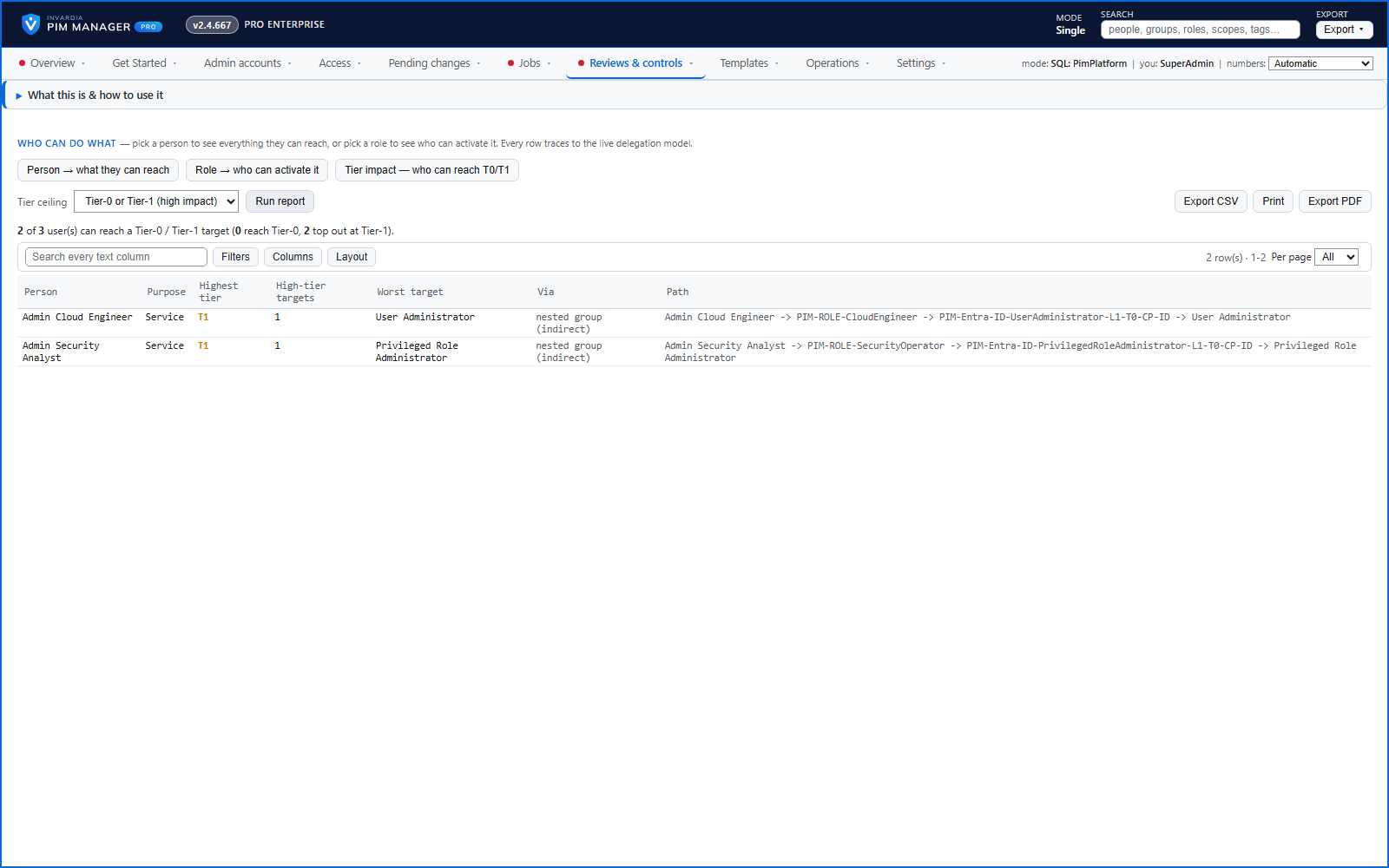
Tier impact report: who can reach Tier 0
The users with a path to Tier 0 or Tier 1 access - including through nested groups - sorted most-privileged first.
How it works →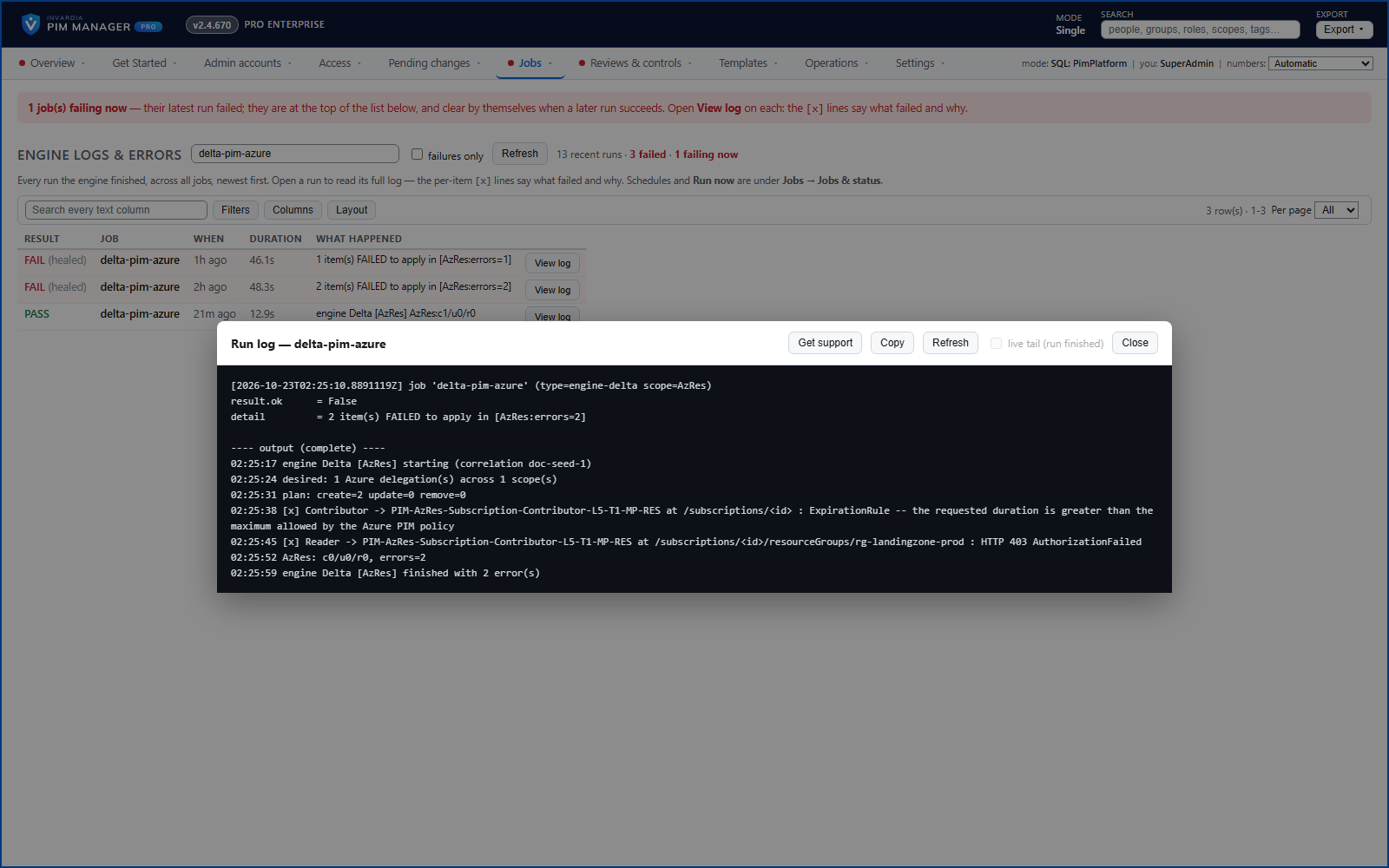
Engine logs and errors, in plain words
Jobs, schedules and each run's log in the Manager; failures named in plain words - the group, the role and the scope - with what to do.
How it works →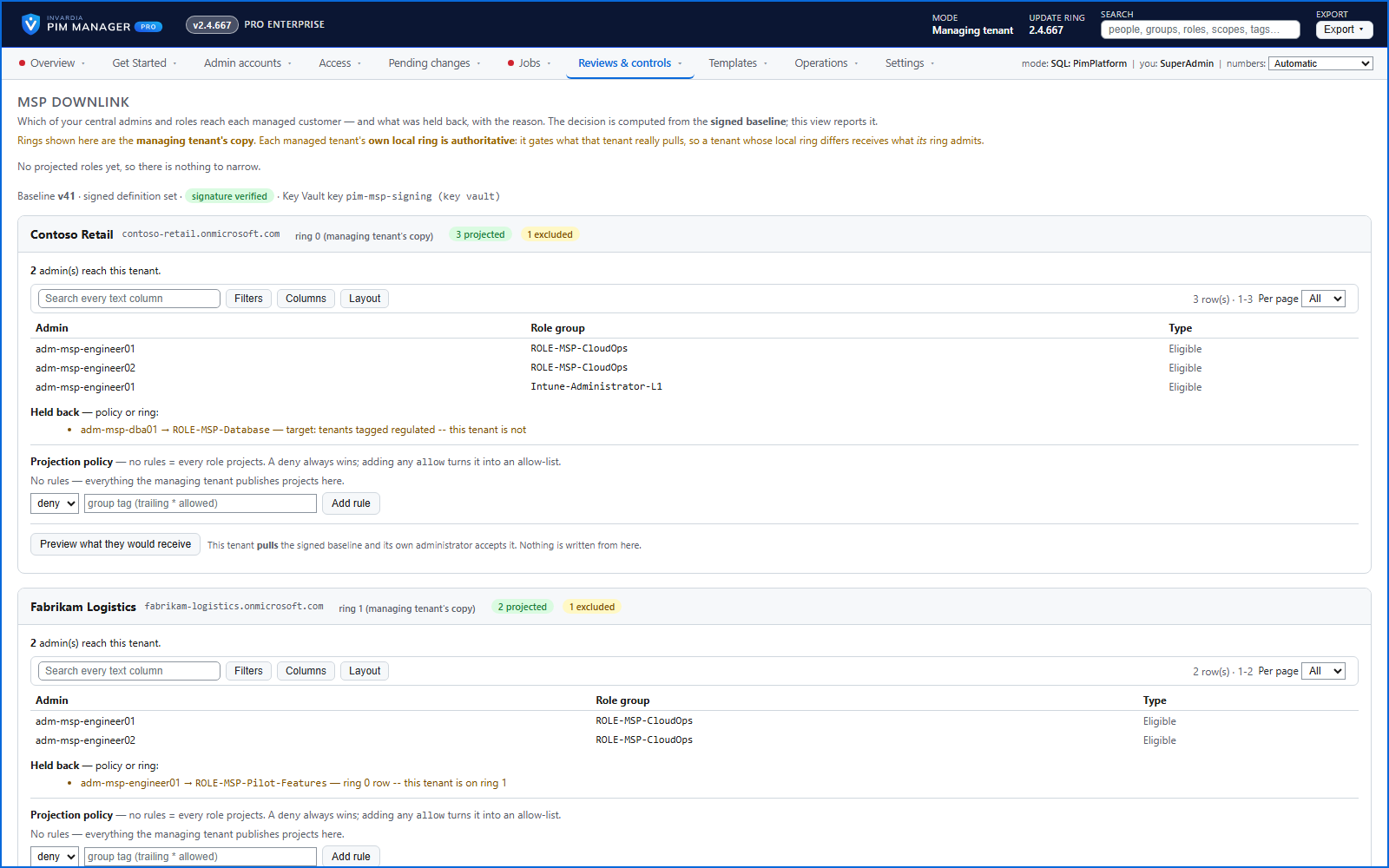
MSP: see what reaches each tenant before you send it
Per row and per tenant: what will arrive, and what is withheld with the reason - computed by the same plan a managed tenant runs.
How it works →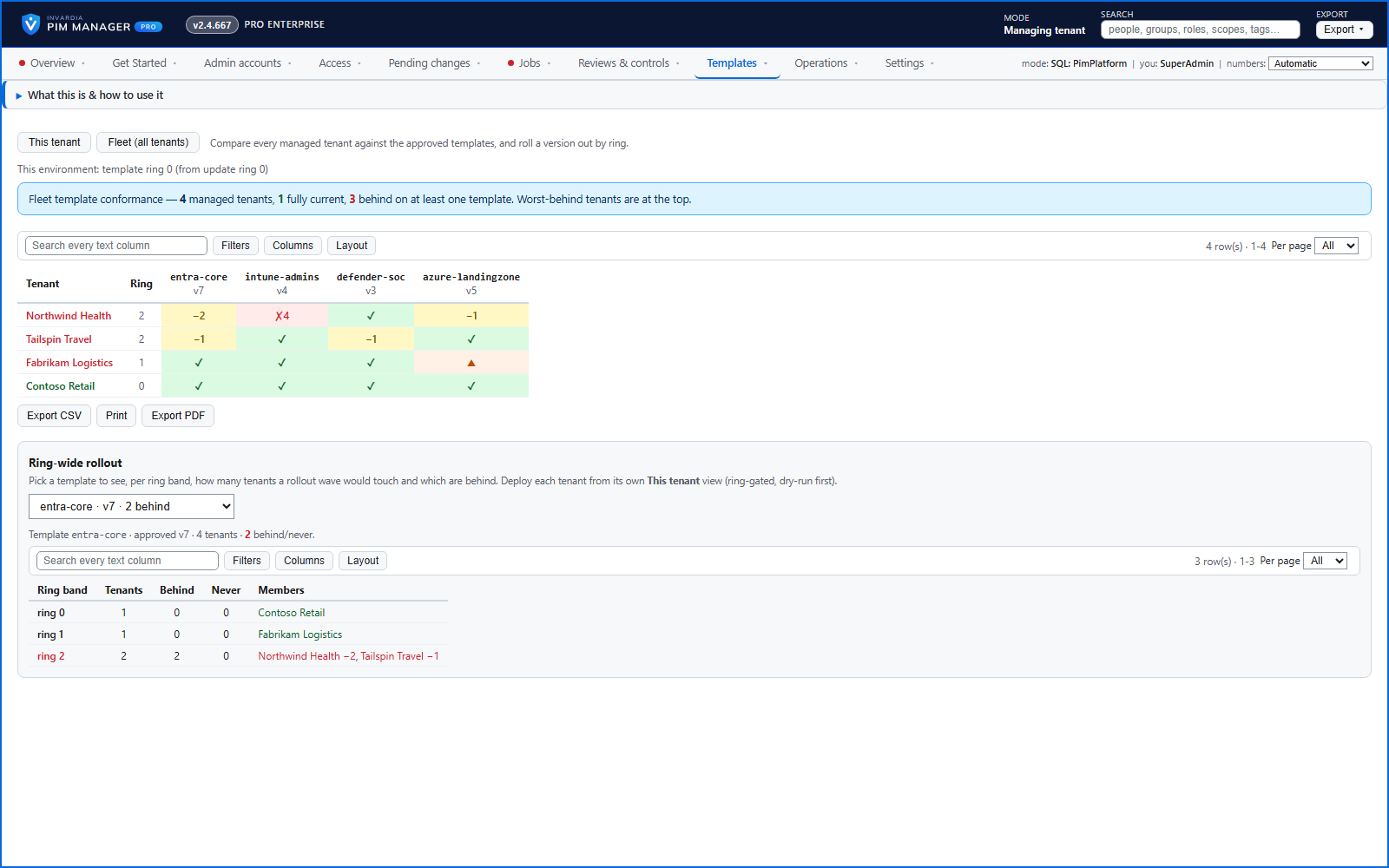
MSP: fleet conformance on one screen
A tenants by templates matrix shows which managed tenant is up to date, behind, not deployed yet or ahead - and plans the next rollout wave.
How it works →Least privilege by design
Access is granted through membership of tiered permission groups and activated just in time - with MFA and approval where the risk is highest.
Access map: your delegation model on one board
Pick a person or a permission and see every path in your delegation model - people, their groups, what those groups include and the roles and scopes they grant.
How it works →Look up a role: find the least-privileged role for the job
See what an Entra ID role can do in plain words, find the roles that grant an action ranked least-privileged first, see who can activate a role, or compare two roles.
How it works →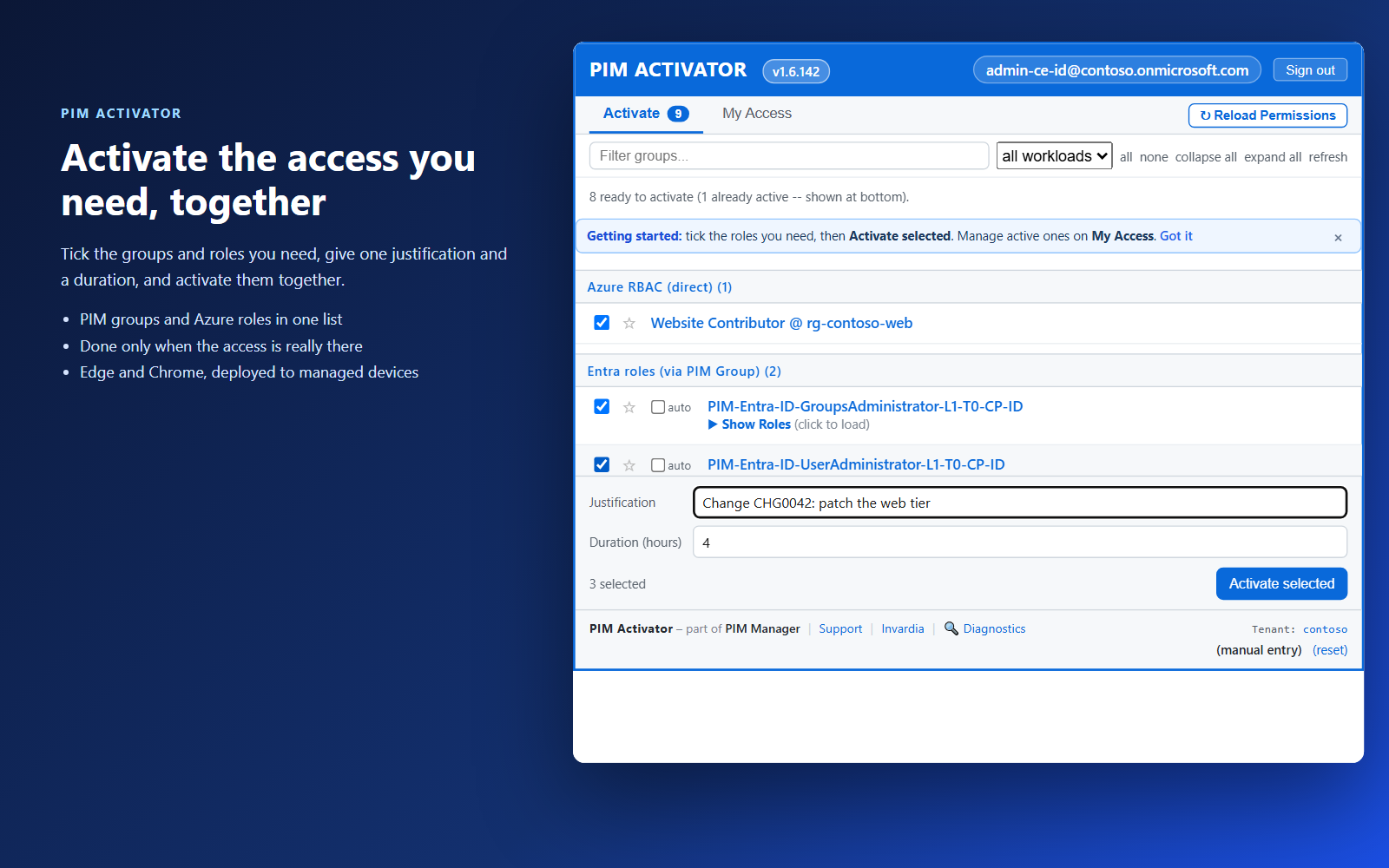
PIM Activator: activate the access you need, together
A browser extension for Edge and Chrome: tick the groups and roles you need, give one justification and activate them together - three clicks for a typical activation.
How it works →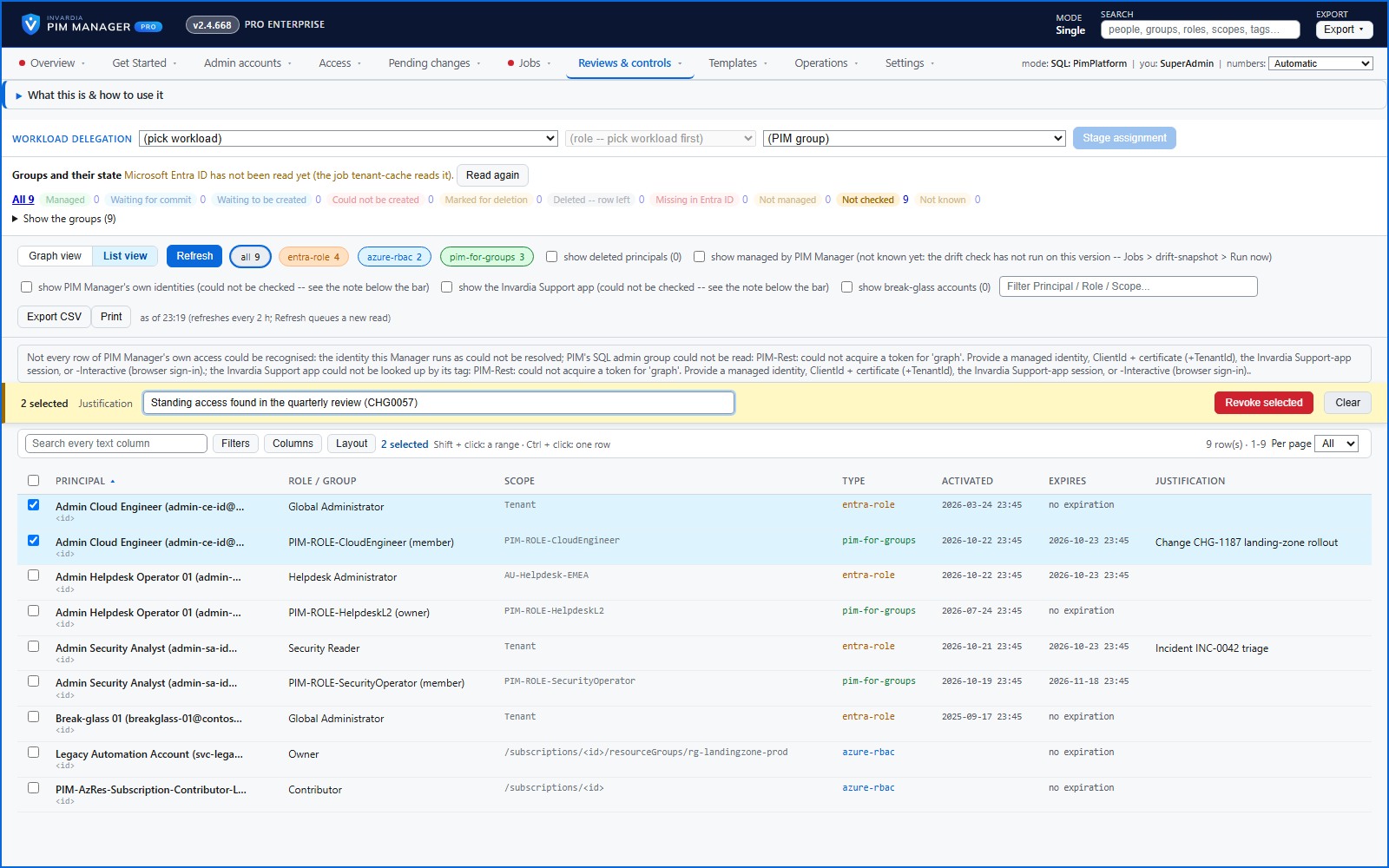
Revoke active access - staged, justified, break-glass accounts skipped
Select active assignments on Delegation overview and revoke them through Pending changes, with a business reason, break-glass accounts skipped and a second administrator for a large batch.
How it works →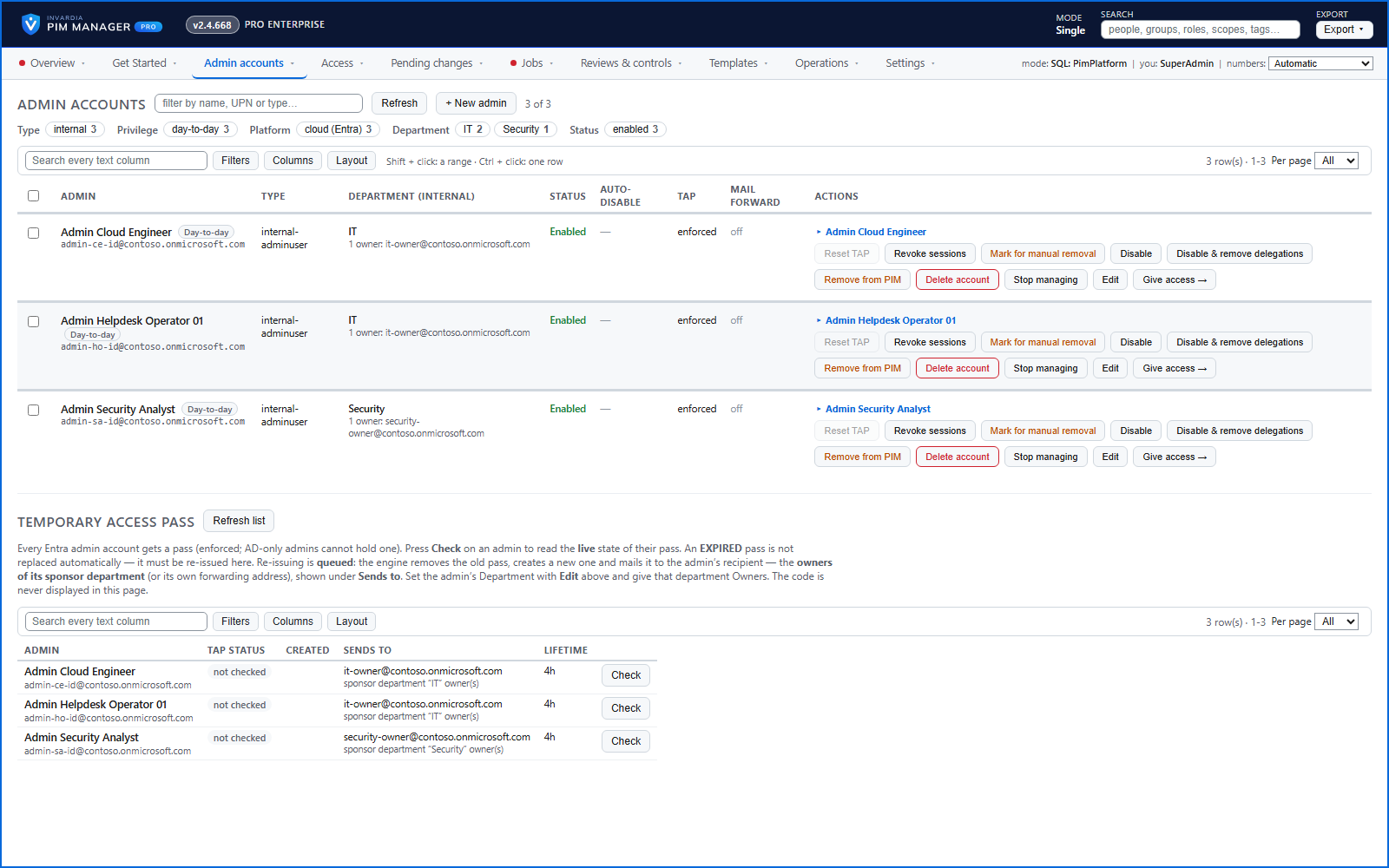
Admin accounts with the full lifecycle
Create admin accounts on a future date, hand over a first-time Temporary Access Pass safely, and disable them on an auto-disable date.
How it works →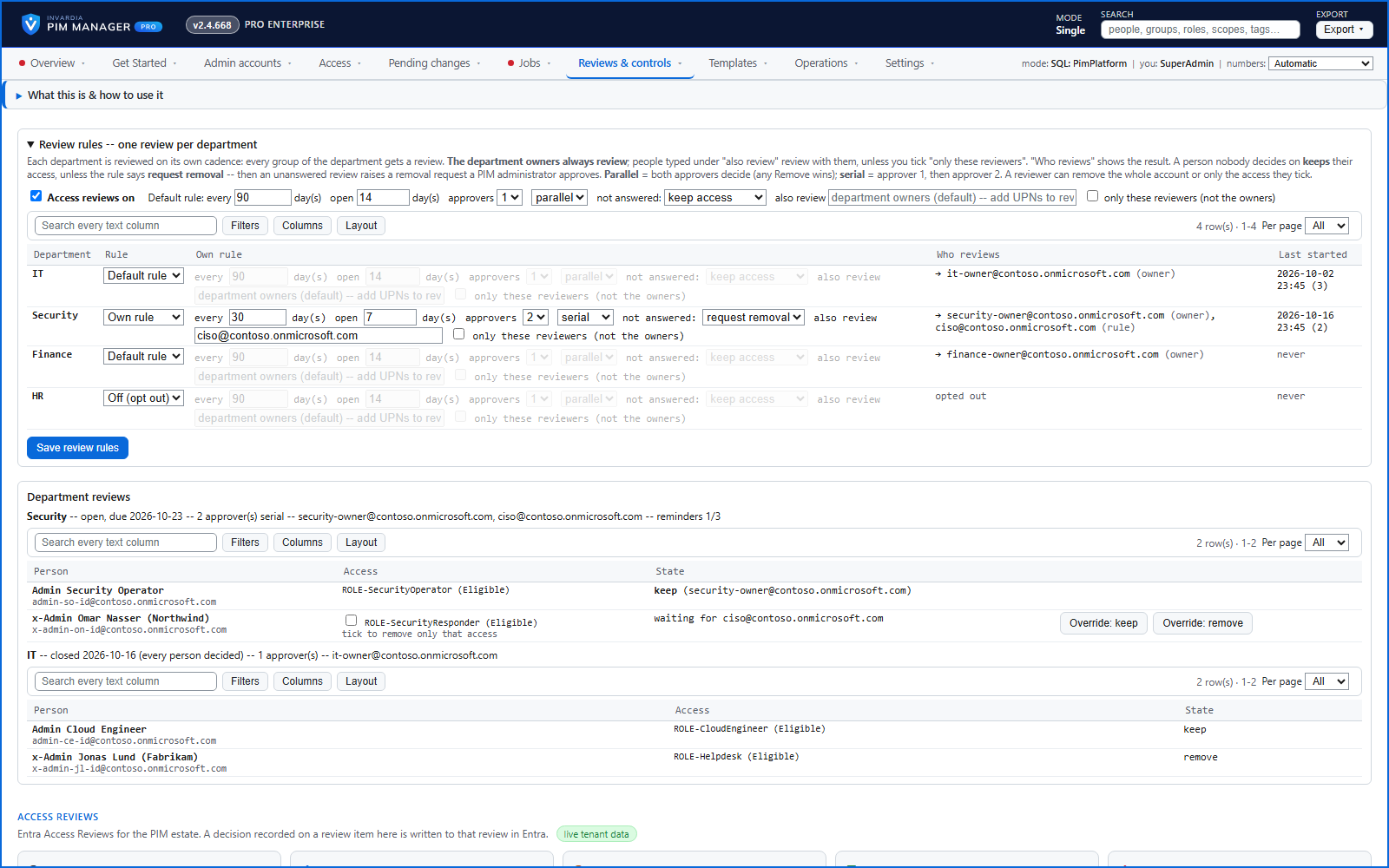
Access reviews per department, carried out by PIM Manager
Department owners decide Keep or Remove for each admin on a cadence you set; decisions pass through an approval or a commit and are recorded as evidence.
How it works →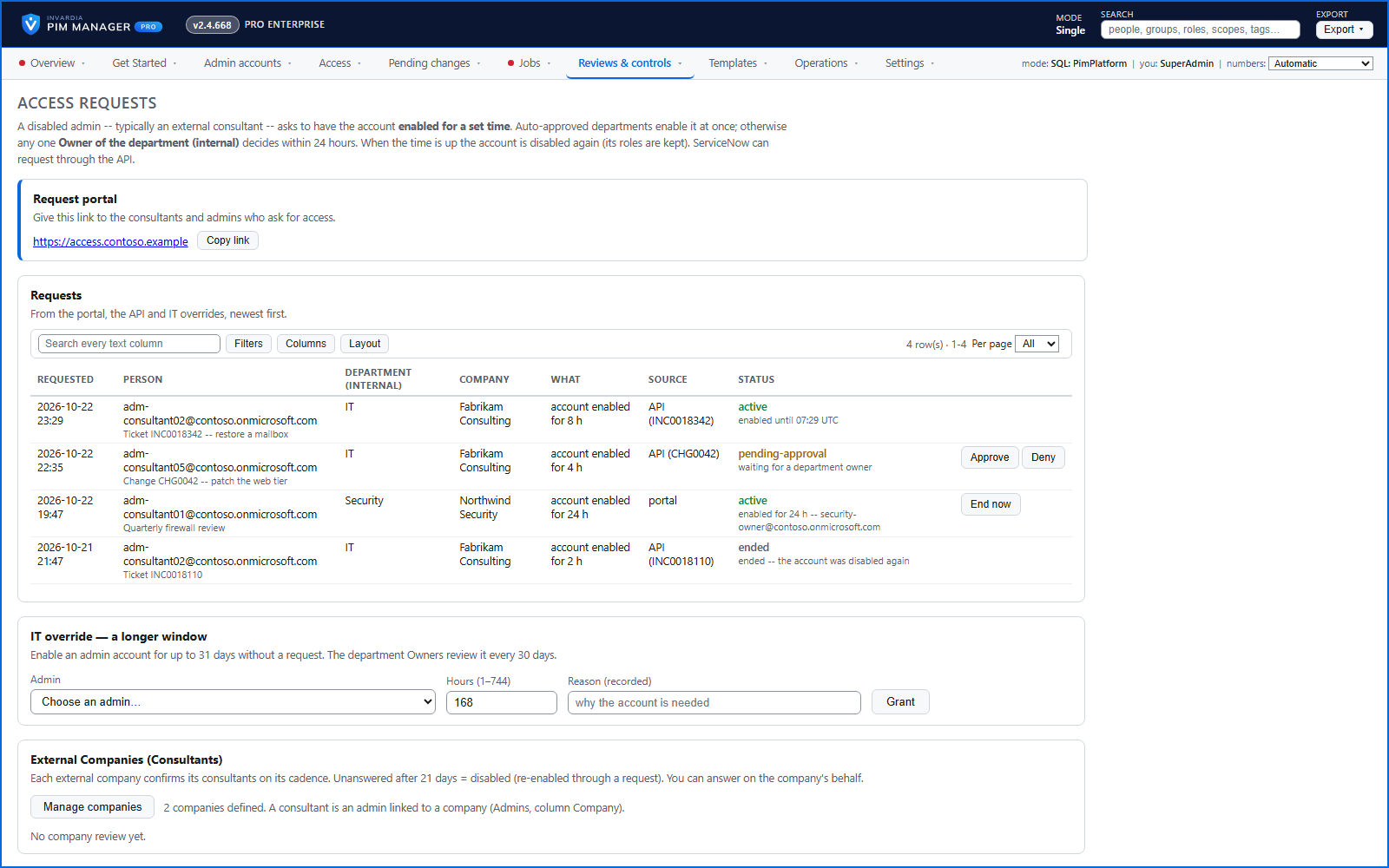
Access request portal: switch on an account, or get temporary group access
A disabled admin or consultant asks for their account back for a set time, or for short-term membership of a permission group you offer - approved, then switched off when the period ends.
How it works →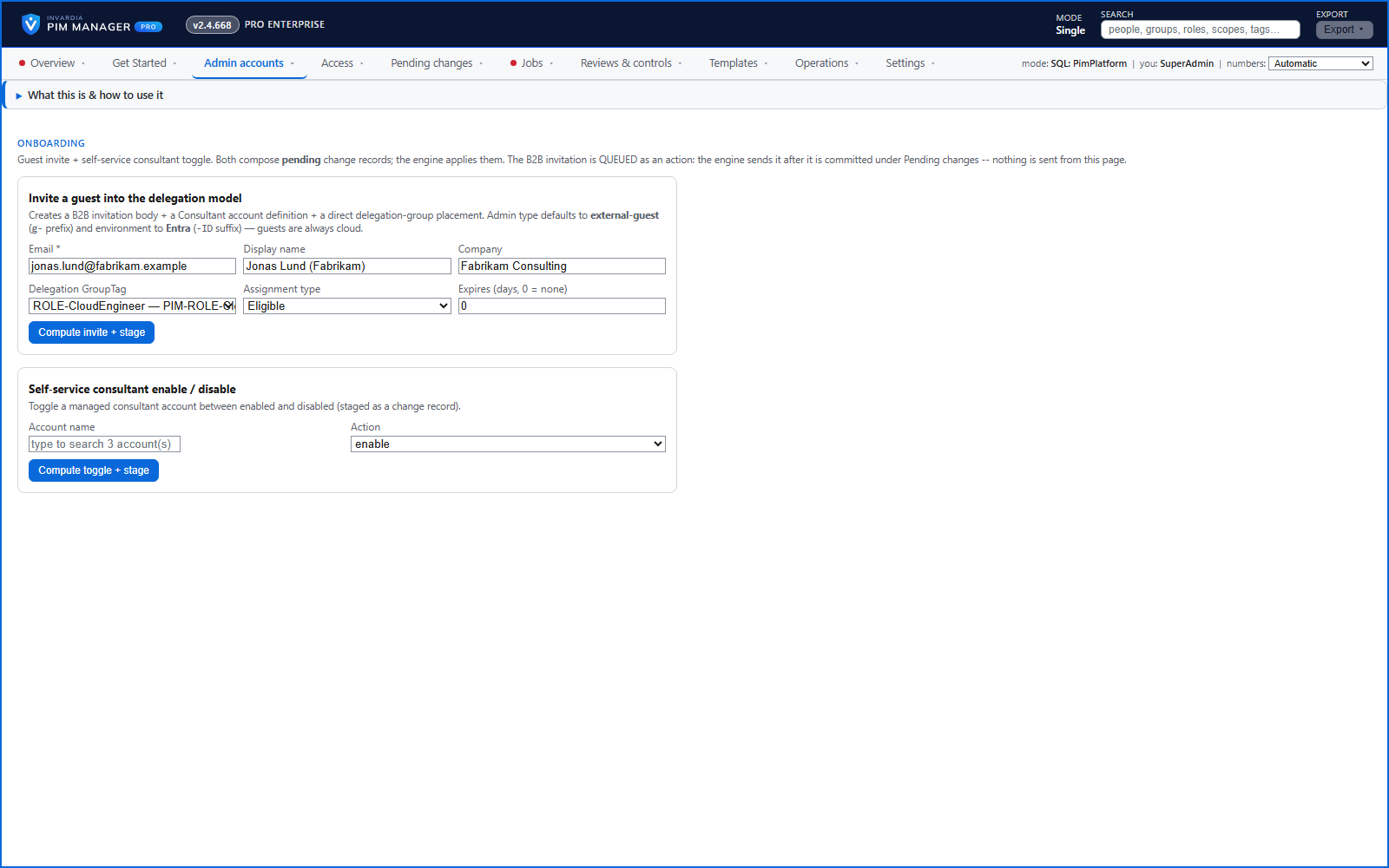
Invite external consultants straight into the delegation model
Invite a consultant as a guest and place them in a delegation group in one staged change; their owner can switch them on and off.
How it works →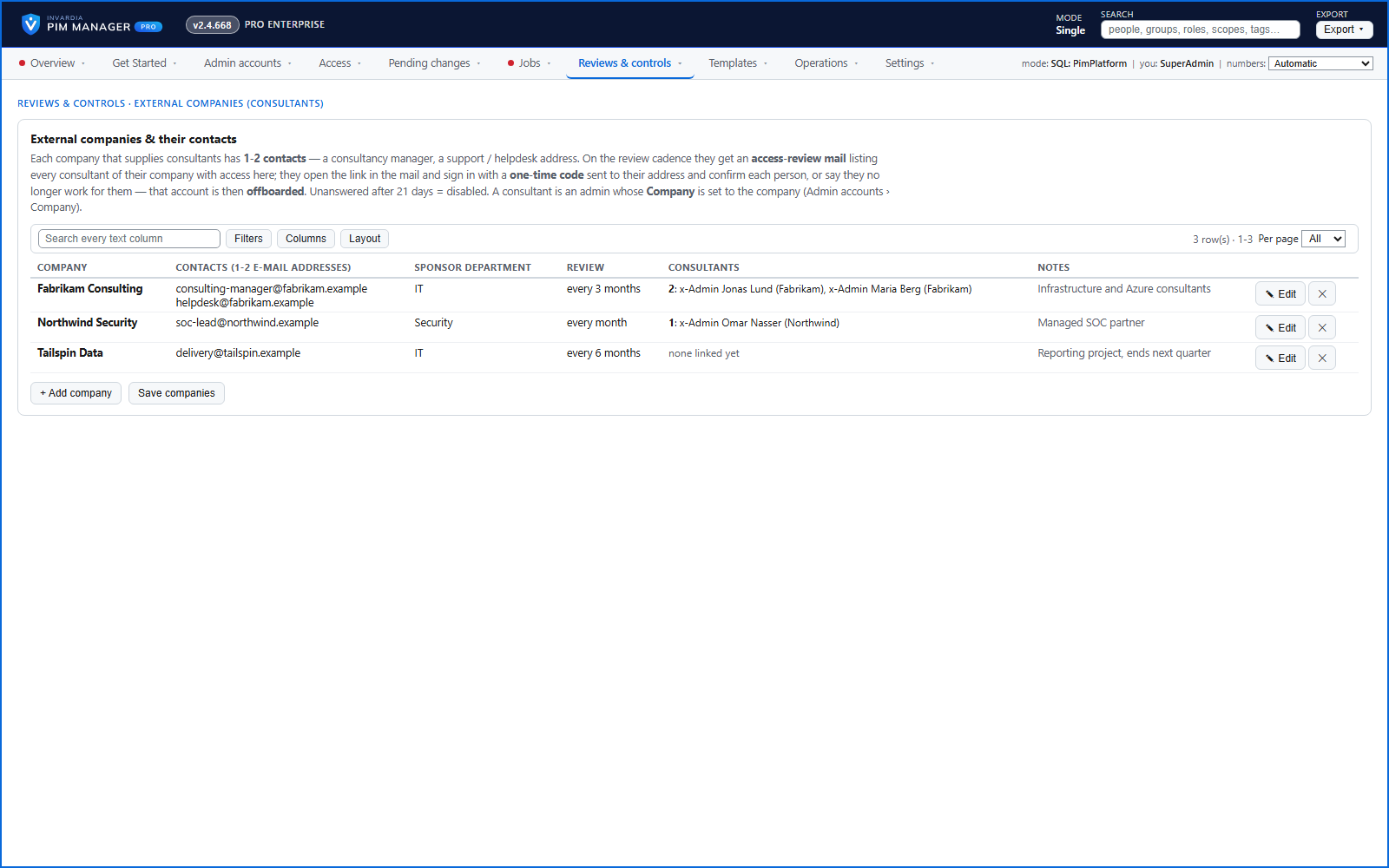
External companies confirm their consultants
Each external company confirms on a cadence who still works for them; a consultant reported as gone is disabled at once.
How it works →Discovery and gaps across your workloads
One page shows what is delegated through PIM Manager and what is not - across Entra ID, Intune, Defender XDR, Power BI, Azure and PIM for Groups - with ready proposals.
How it works →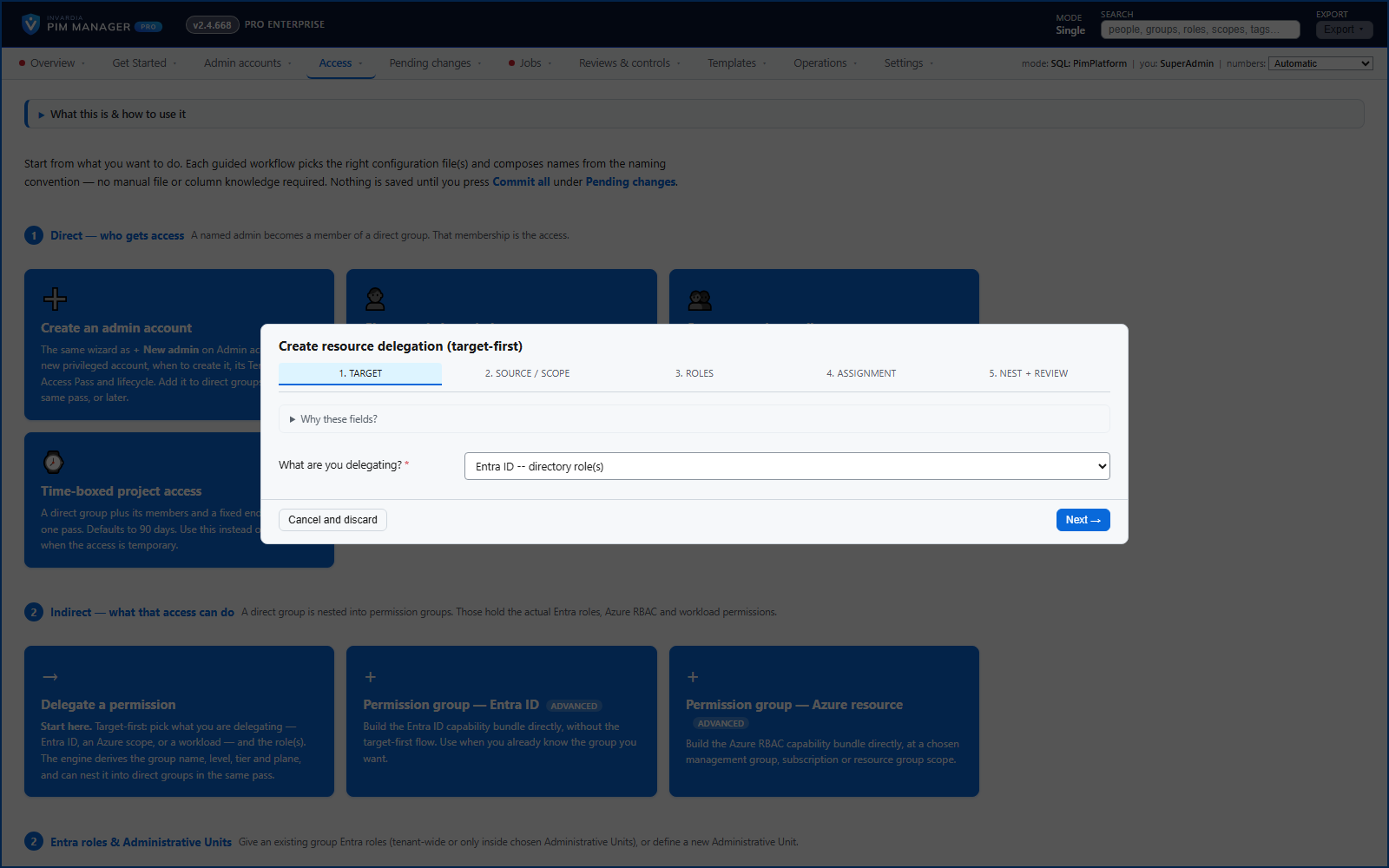
Entra ID, Azure, Intune and Defender XDR from one model
Entra ID roles, PIM for Groups, administrative units, Azure roles, Intune roles and Defender XDR roles - granted the same way, through groups.
How it works →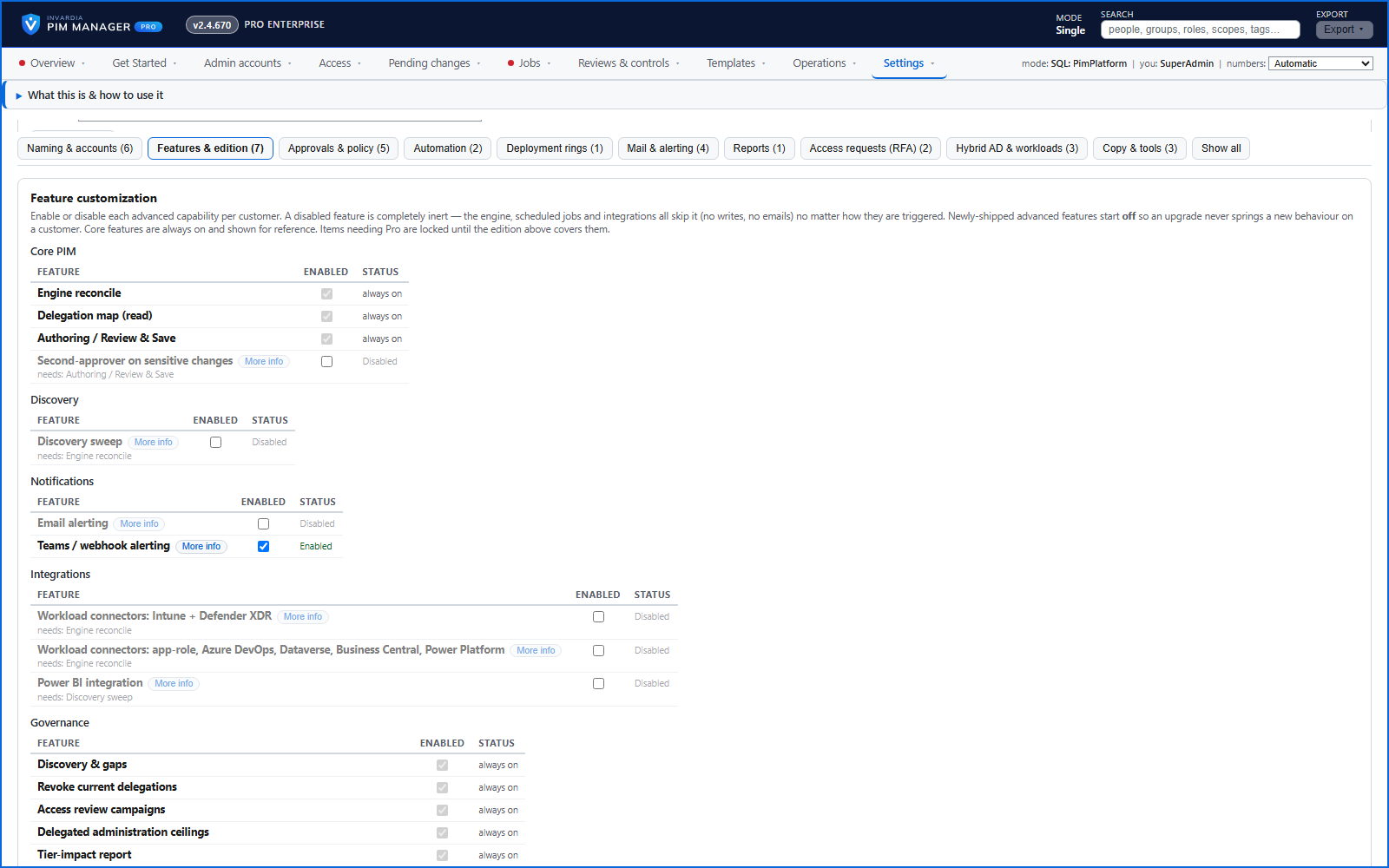
More workloads: Power BI, enterprise apps, Azure DevOps, Dataverse and more
Grant the same groups Power BI workspace access, app roles in enterprise applications, and roles in Azure DevOps, Dataverse, Business Central and Power Platform.
How it works →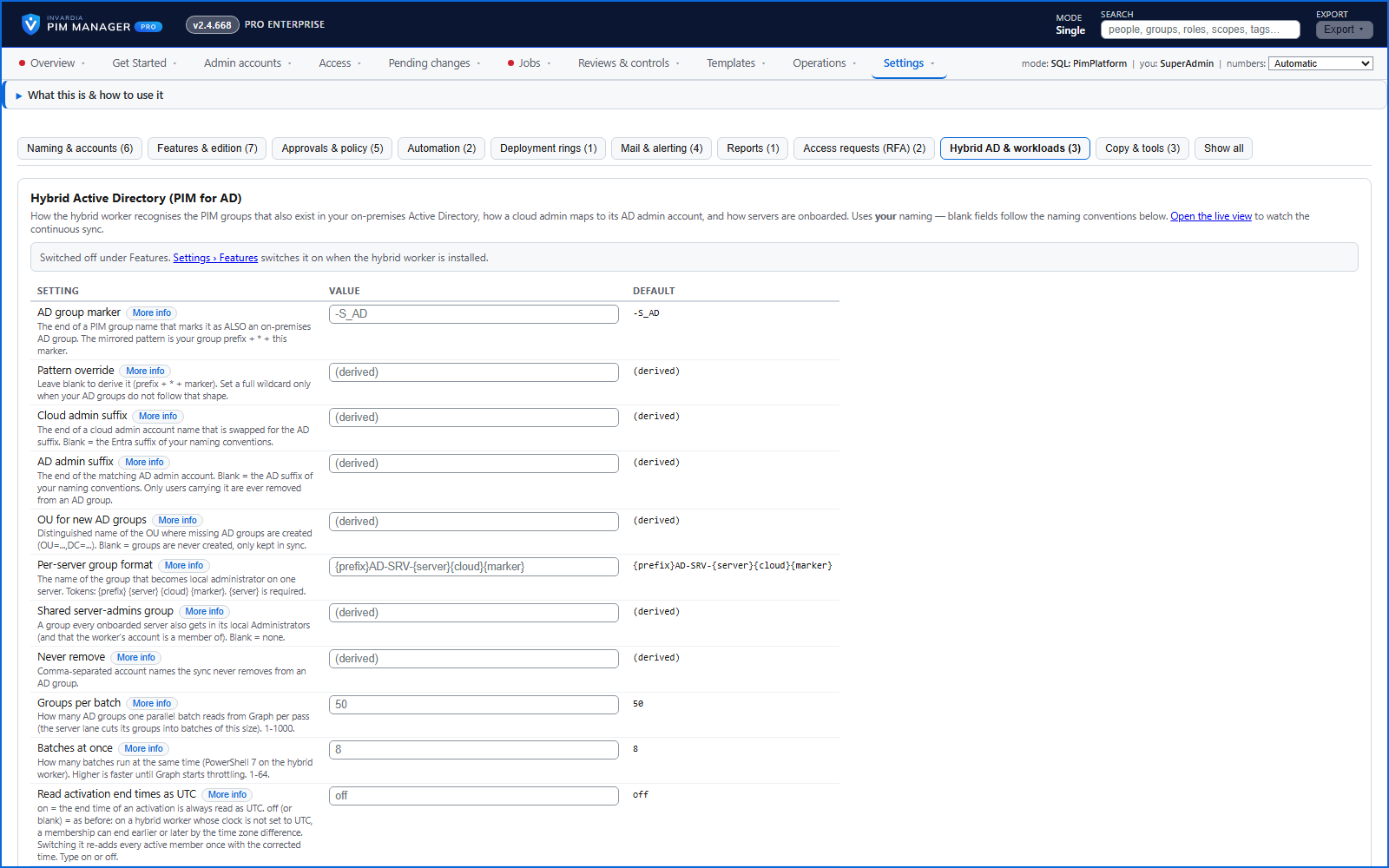
PIM for on-premises Active Directory
Just-in-time membership of on-premises AD groups, driven by PIM activation in the cloud and applied by a small hybrid worker.
How it works →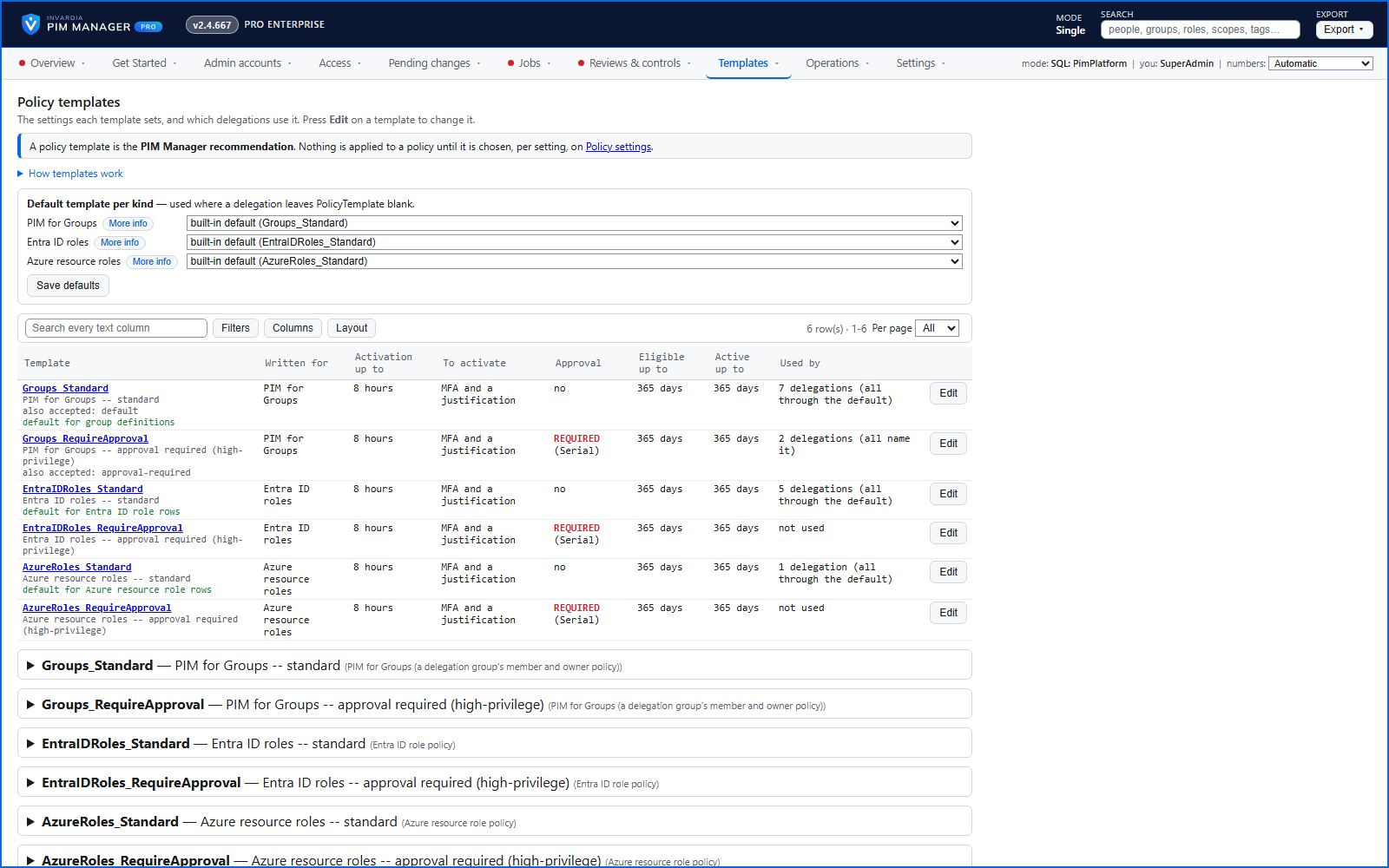
Policy templates you choose, changed only with approval
A Standard and a RequireApproval template per kind - PIM for Groups, Entra ID roles and Azure roles - shown in plain words with the delegations that use them.
How it works →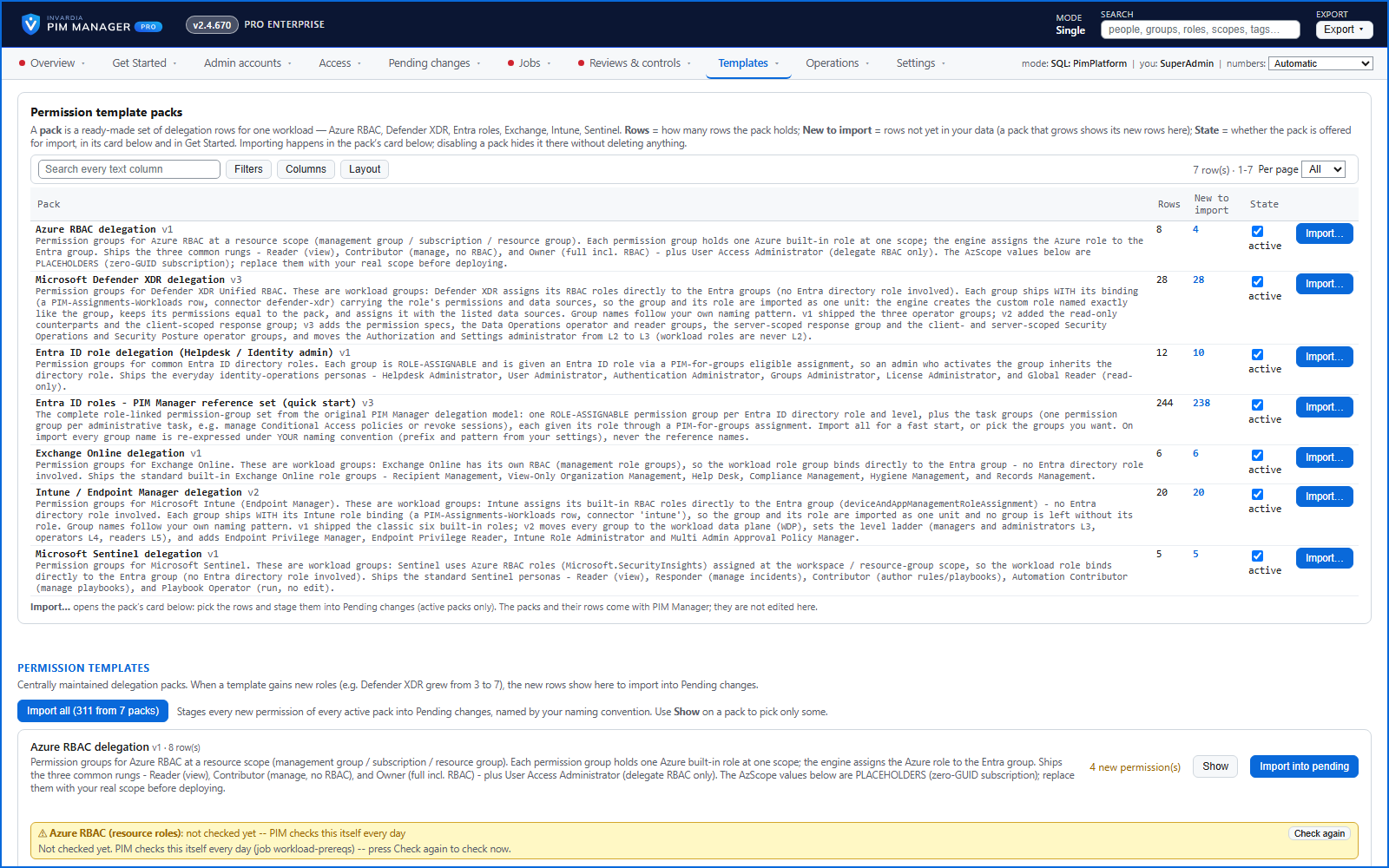
Ready-made permission packs
Ready-made permission groups for Azure RBAC, Defender XDR, Entra ID, Exchange Online, Intune and Microsoft Sentinel - import the rows you tick. For Exchange Online and Sentinel the pack creates the groups; you give them their role there.
How it works →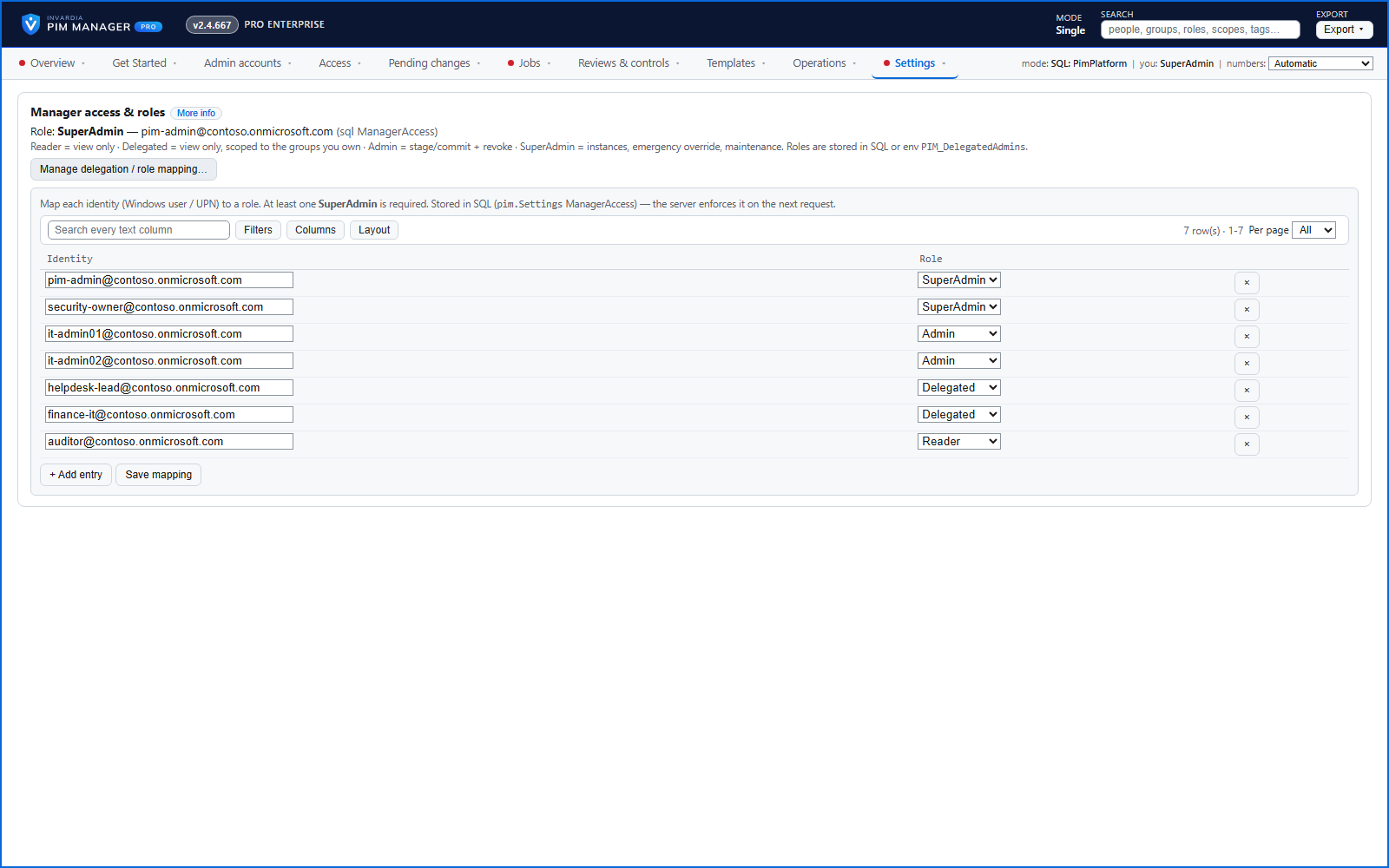
Delegated administration of the Manager
Each identity is a Reader, Delegated, Admin or SuperAdmin in the Manager; a Delegated user, limited by tier, level, service or scope, sees and changes only what they own.
How it works →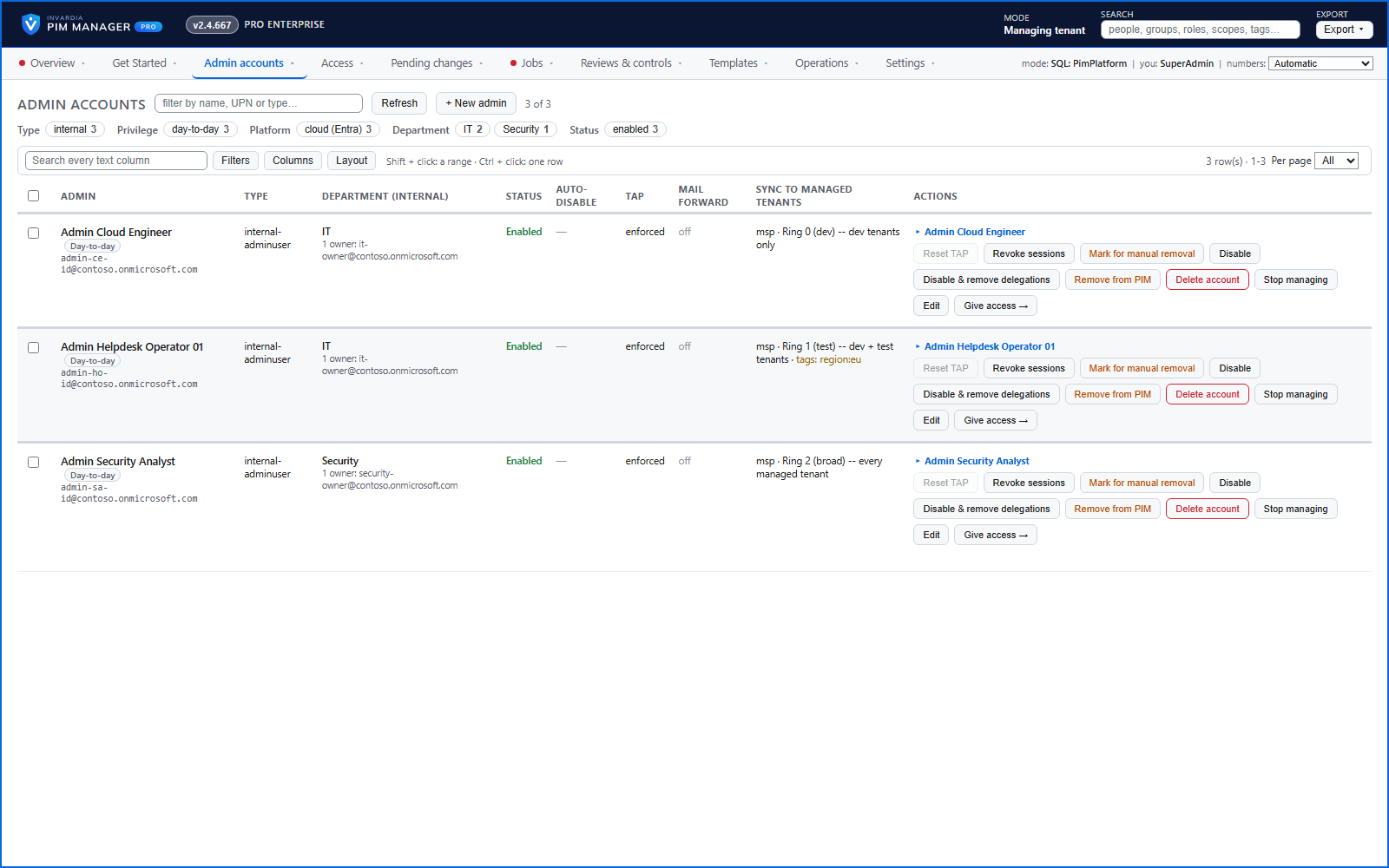
MSP: central admin accounts, removed across tenants at once
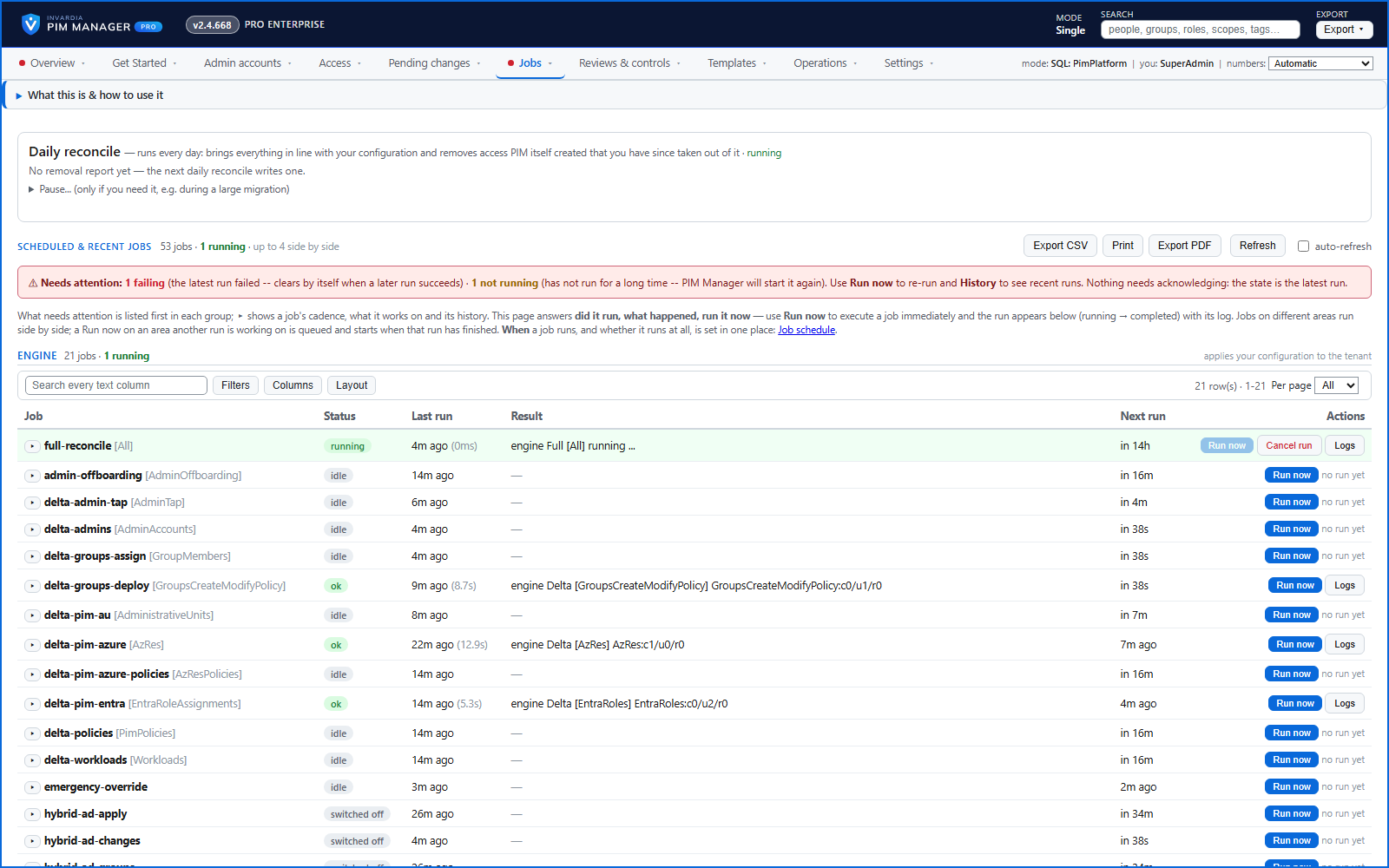
Provider admins flow down to the tenants that need them, with status and auto-disable date - and a leaver's access ends in the managed tenants on their next sync.
How it works →Change without fear
Each change you make is staged, reviewed, backed up first and reversible. The engine changes only what your data defines, and guards hold a run that would remove or disable too much at once.
An engine that keeps your tenant matching your model
You describe the access you want; the engine creates the groups, owners, policies, assignments and access passes your data defines, and keeps them that way.
How it works →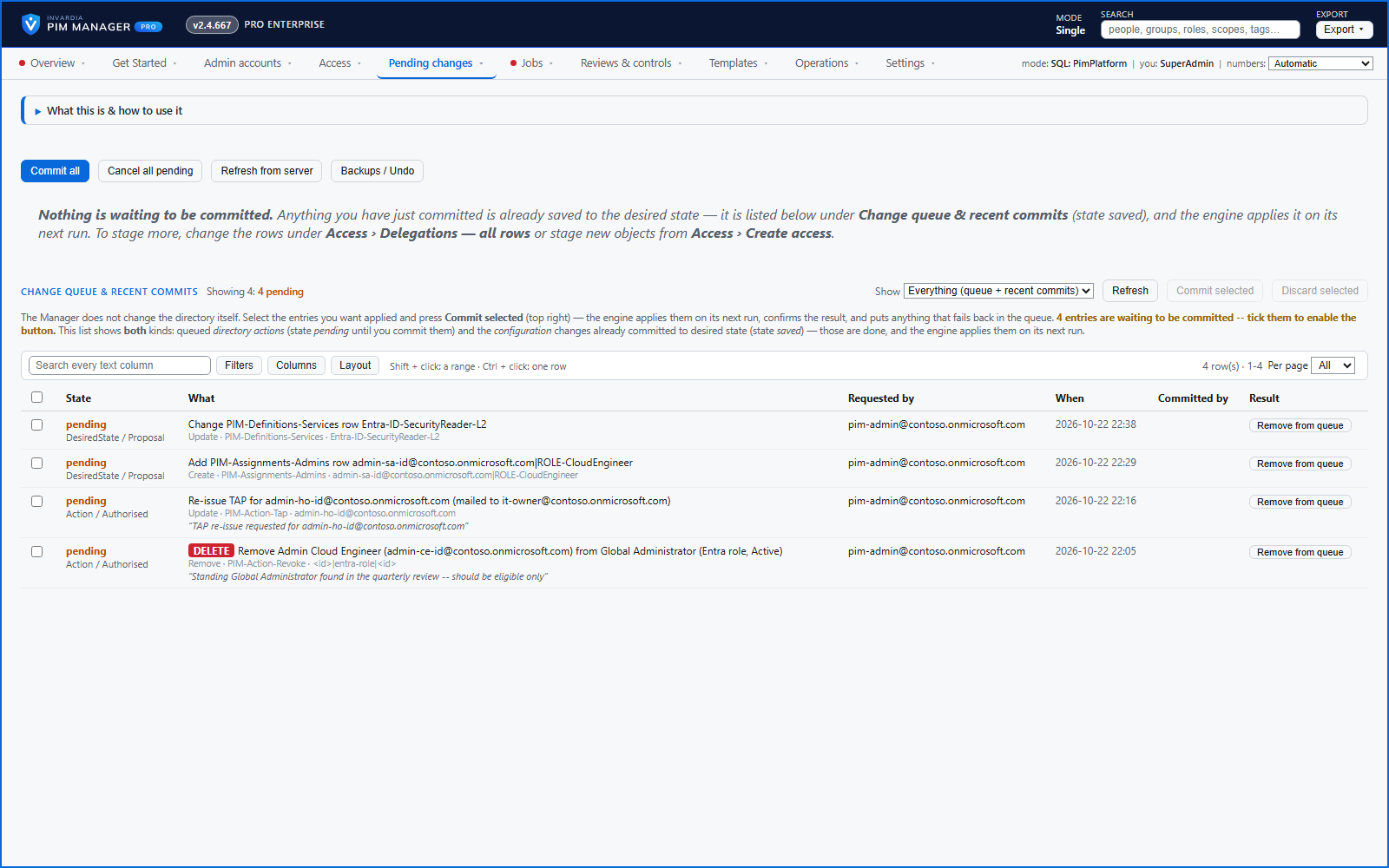
One queue for the changes you make - reviewed, backed up, reversible
Configuration edits, revokes, access-pass re-issues and session revokes wait in one queue until someone commits them.
How it works →Drift: live versus desired, with a decision for each difference
See what is missing, what was changed and what is extra in the tenant - and decide what happens to each item: Apply now, Import into PIM, Delete, Ignore or Re-add.
How it works →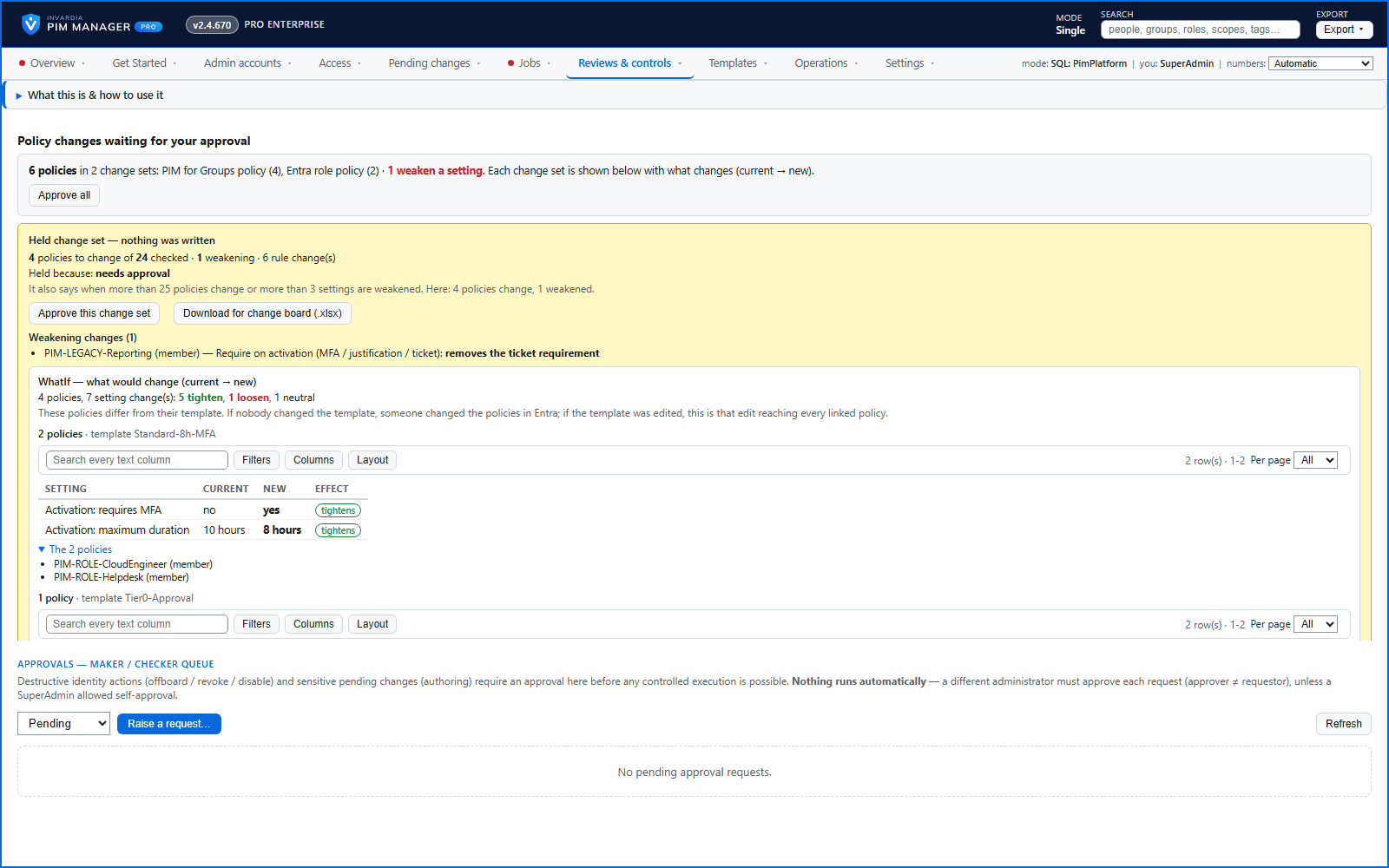
PIM policy changes wait for a SuperAdmin
A policy run plans its changes and holds them until a SuperAdmin approves that exact change set, with the setting that weakens protection marked.
How it works →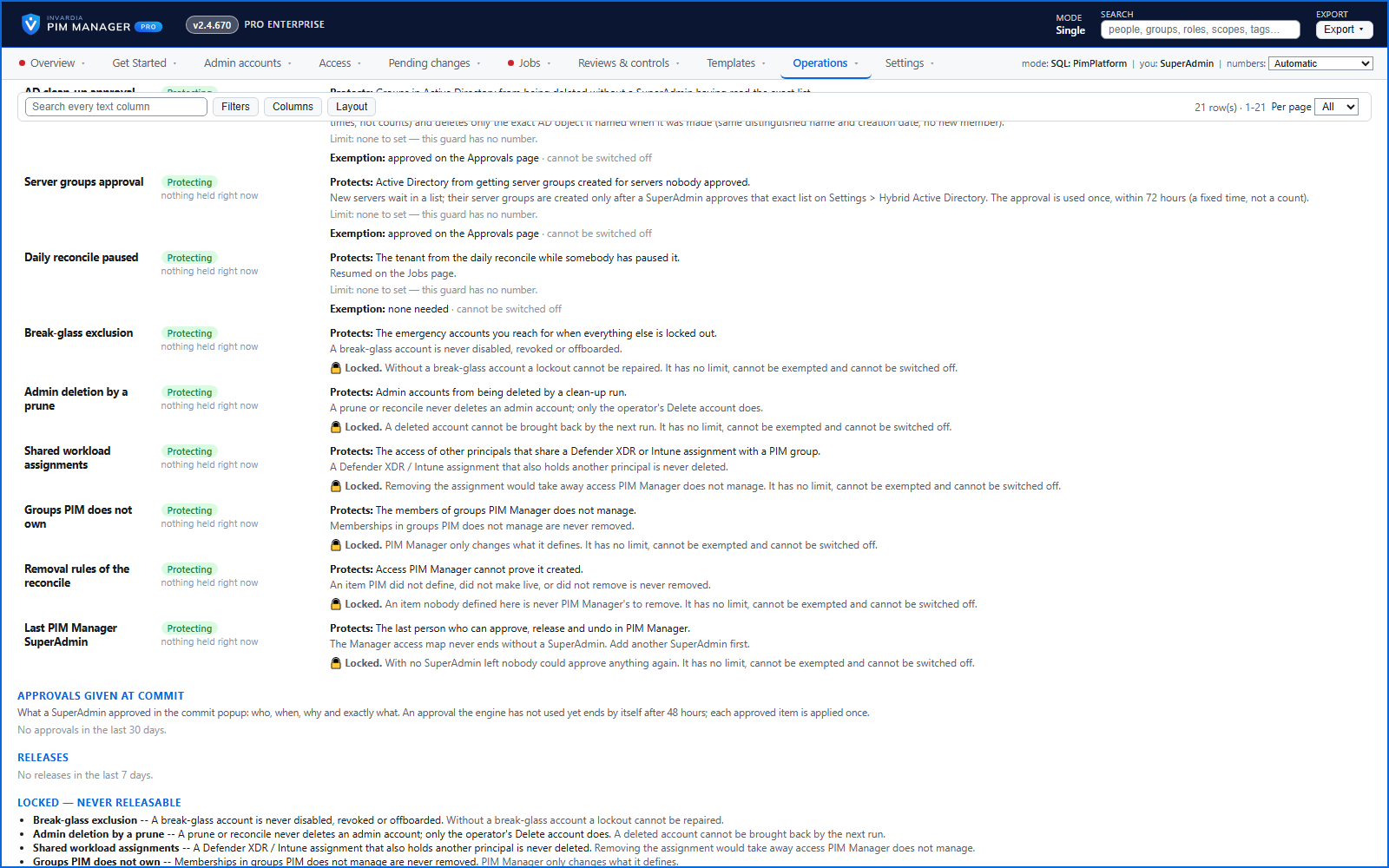
Changes only what you define - deleting an account is a person's decision
The engine changes groups, roles and admins only when your data defines them, does not disable, revoke or offboard your break-glass accounts, and does not delete a user account on its own.
How it works →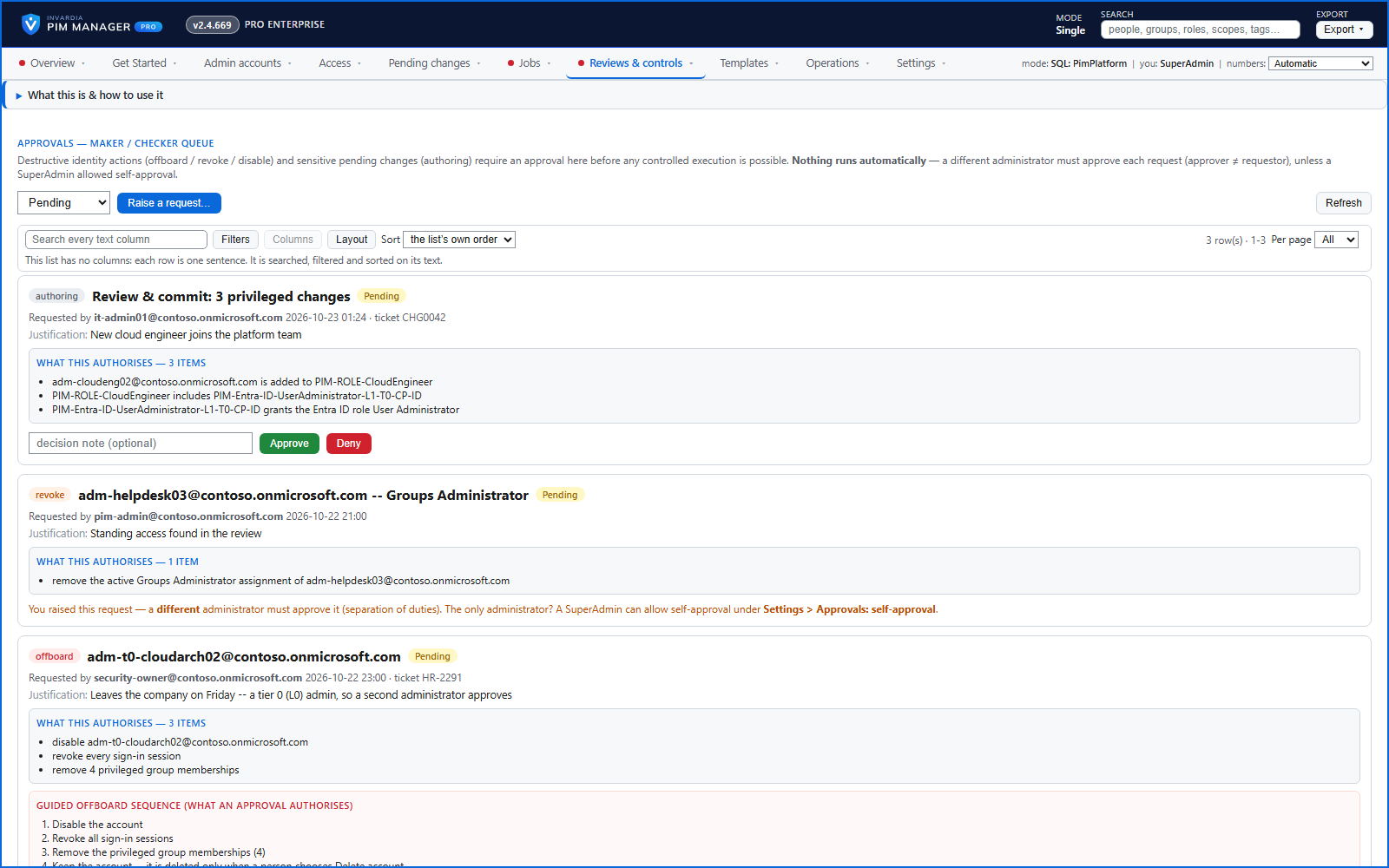
A second administrator for sensitive changes
Maker and checker: with the second approver on, the most sensitive changes need a different administrator's approval before they are carried out. It is in every edition and off by default.
How it works →Revoke active access - staged, justified, break-glass accounts skipped
Select active assignments on Delegation overview and revoke them through Pending changes, with a business reason, break-glass accounts skipped and a second administrator for a large batch.
How it works →Policy templates you choose, changed only with approval
A Standard and a RequireApproval template per kind - PIM for Groups, Entra ID roles and Azure roles - shown in plain words with the delegations that use them.
How it works →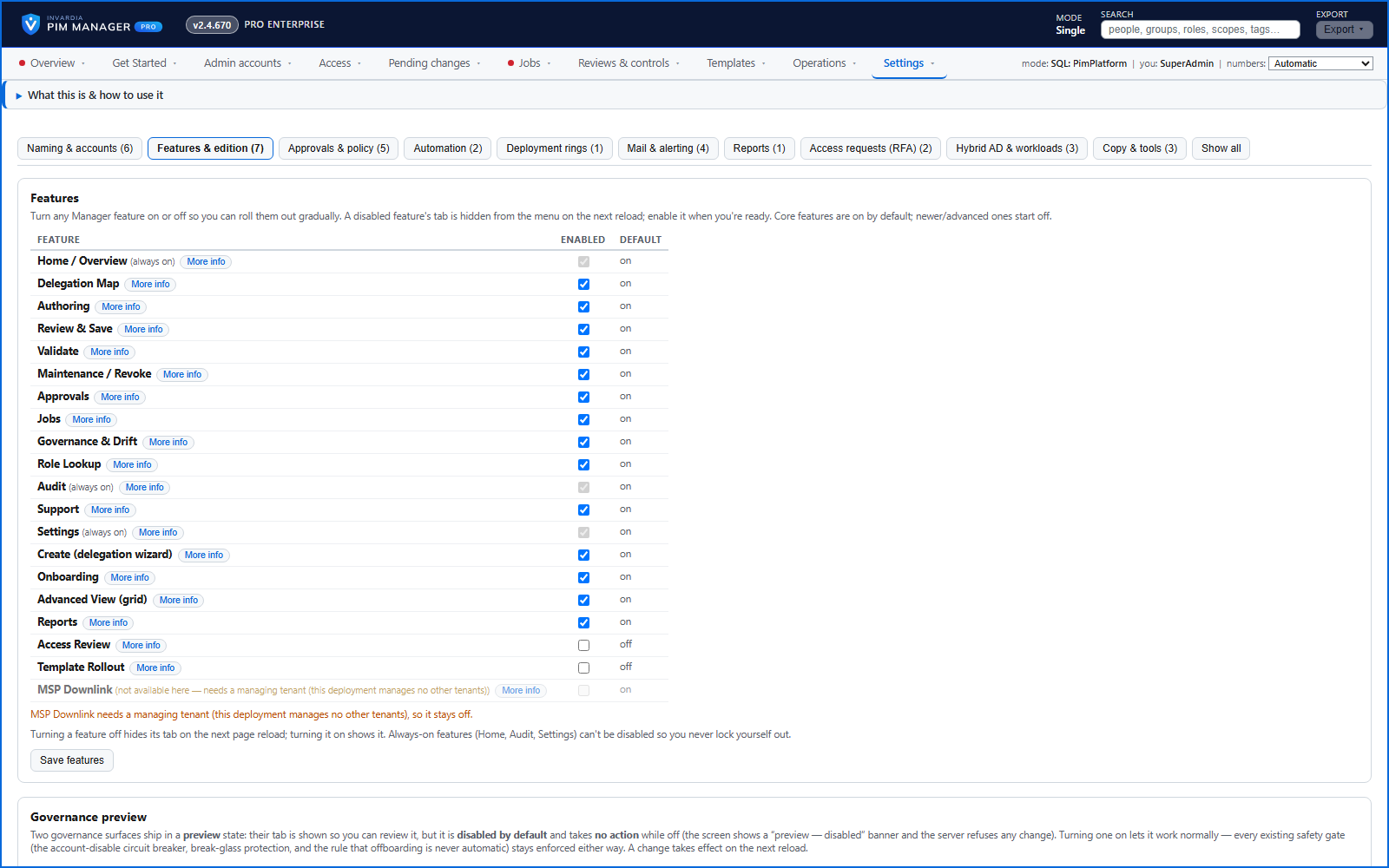
Switch capabilities on one at a time
Each optional capability has an on/off switch, advanced ones start off, and off means the engine and the scheduled jobs skip it.
How it works →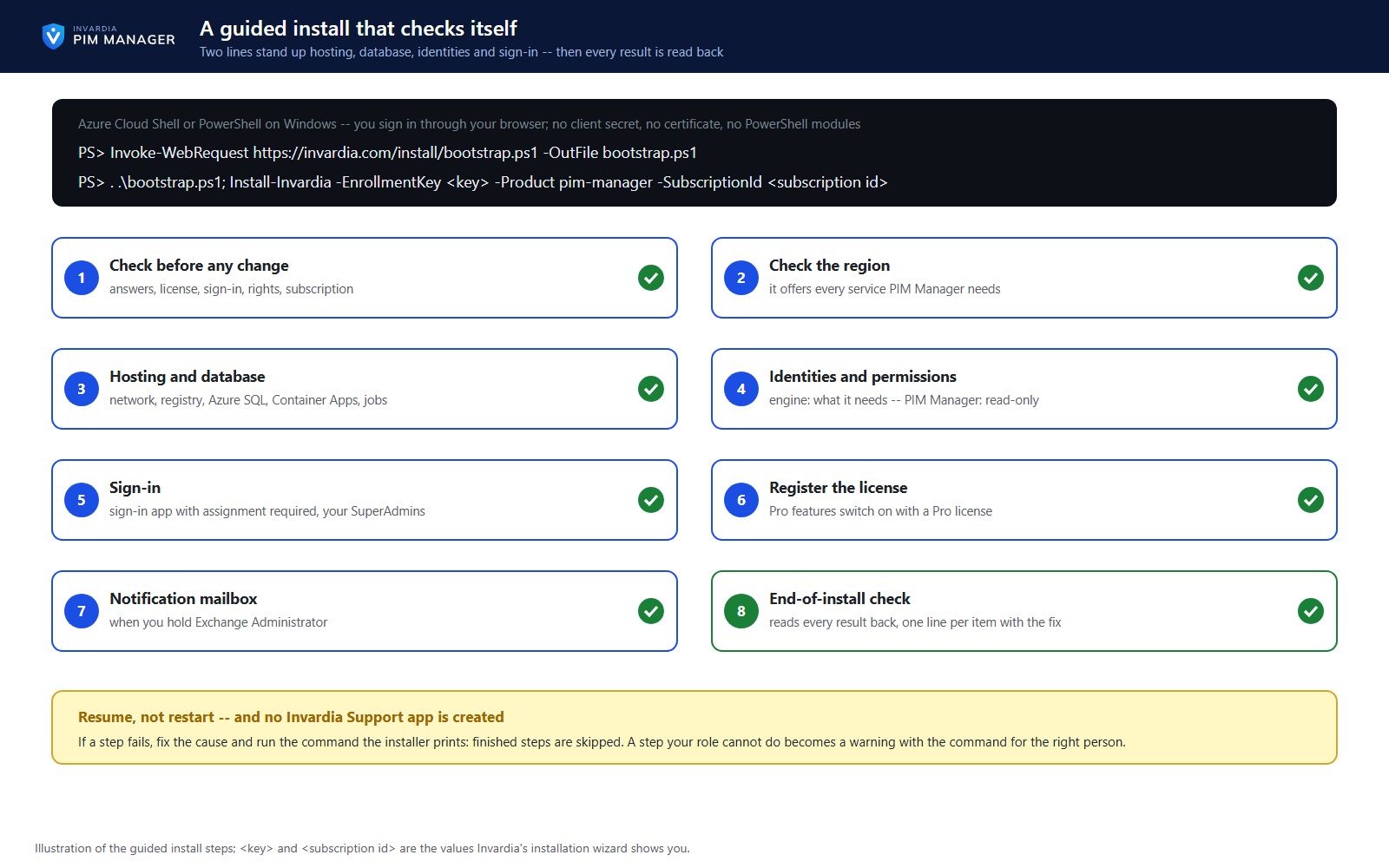
A guided install that proves itself
A guided two-line install stands up hosting, database, identities and permissions, and sign-in - then reads every result back, and resumes from a failed step once you fix the cause.
How it works →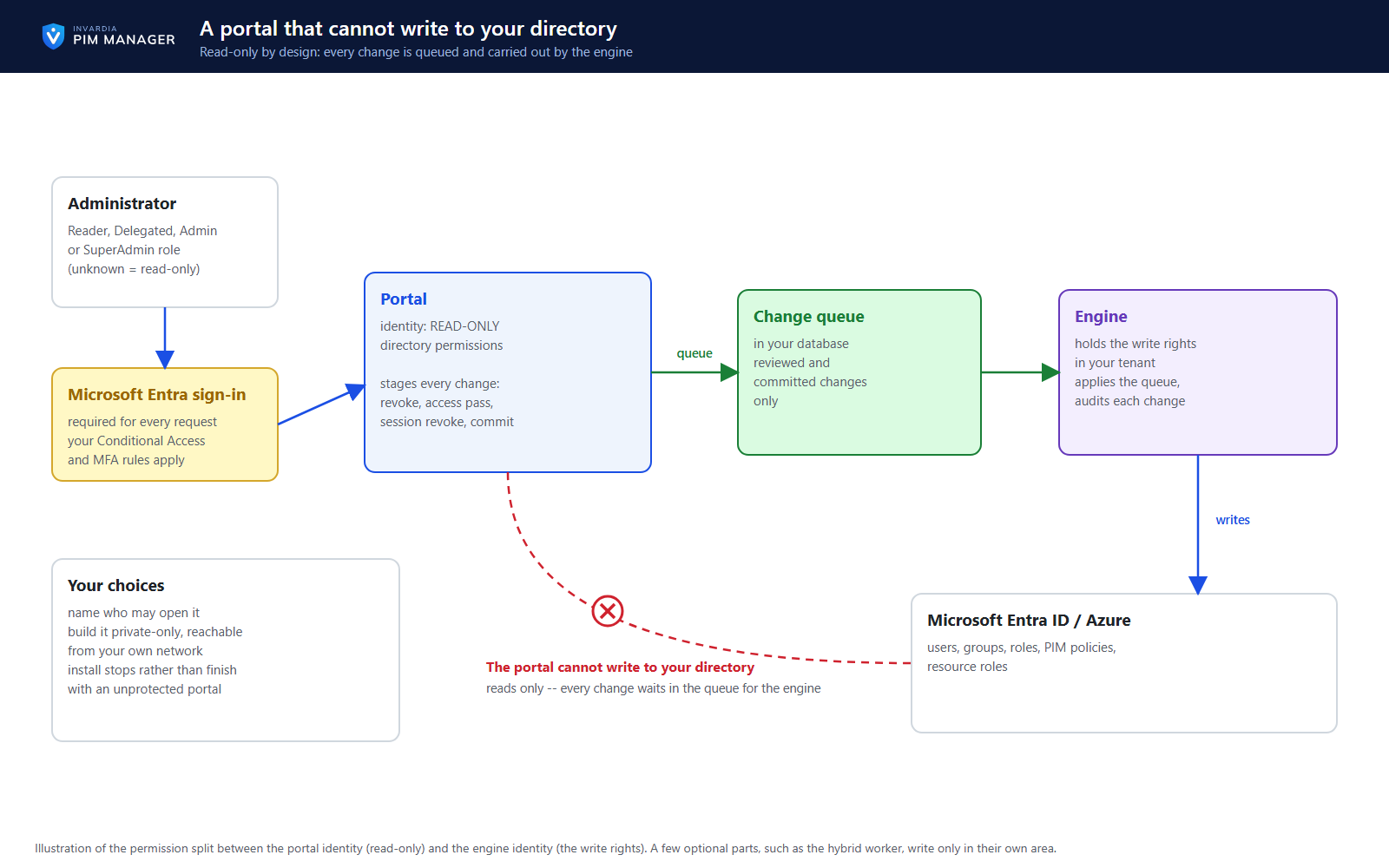
A portal whose identity only reads your directory
The portal's identity has read-only directory permissions; changes are queued and carried out by the engine. Each visit requires Entra sign-in.
How it works →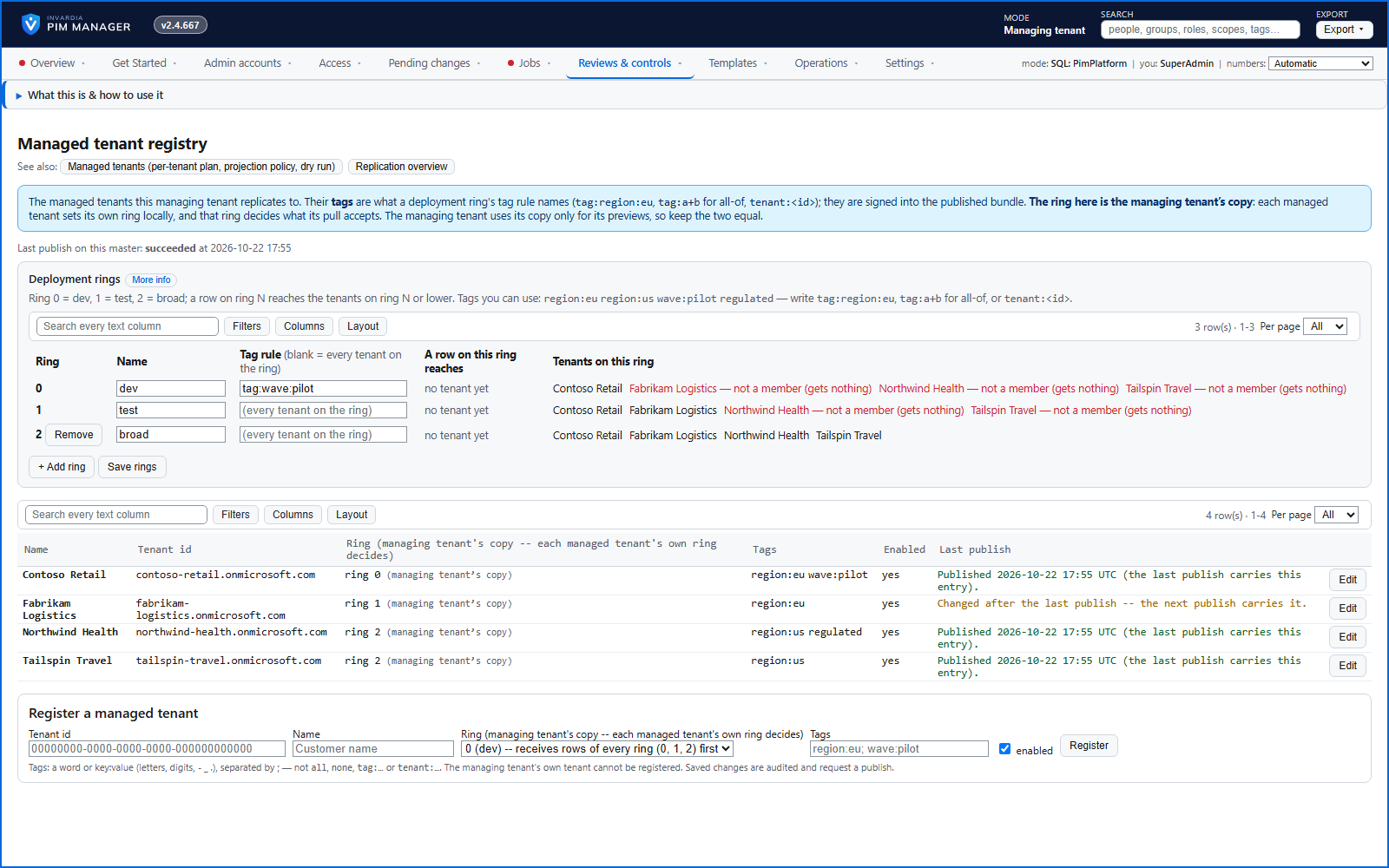
MSP: roll a change out to a first group of customers
Rollout waves decide which managed tenants receive each row, so a change reaches a first group of tenants before the rest.
How it works →MSP: see what reaches each tenant before you send it
Per row and per tenant: what will arrive, and what is withheld with the reason - computed by the same plan a managed tenant runs.
How it works →Prove compliance
One append-only audit trail with before and after values, access reviews whose decisions are carried out, and reports that show auditors who can reach your most privileged roles.
Who can do what - and who can activate this role
Pick a person to see the targets they can reach, or pick a role to see who can activate it - each with the exact path that grants it.
How it works →One queue for the changes you make - reviewed, backed up, reversible
Configuration edits, revokes, access-pass re-issues and session revokes wait in one queue until someone commits them.
How it works →A second administrator for sensitive changes
Maker and checker: with the second approver on, the most sensitive changes need a different administrator's approval before they are carried out. It is in every edition and off by default.
How it works →Delegation overview: the active privileged assignments right now
The active Entra ID role, Azure role and PIM for Groups assignments in your tenant in one view, opening at once from a stored snapshot.
How it works →Access reviews per department, carried out by PIM Manager
Department owners decide Keep or Remove for each admin on a cadence you set; decisions pass through an approval or a commit and are recorded as evidence.
How it works →External companies confirm their consultants
Each external company confirms on a cadence who still works for them; a consultant reported as gone is disabled at once.
How it works →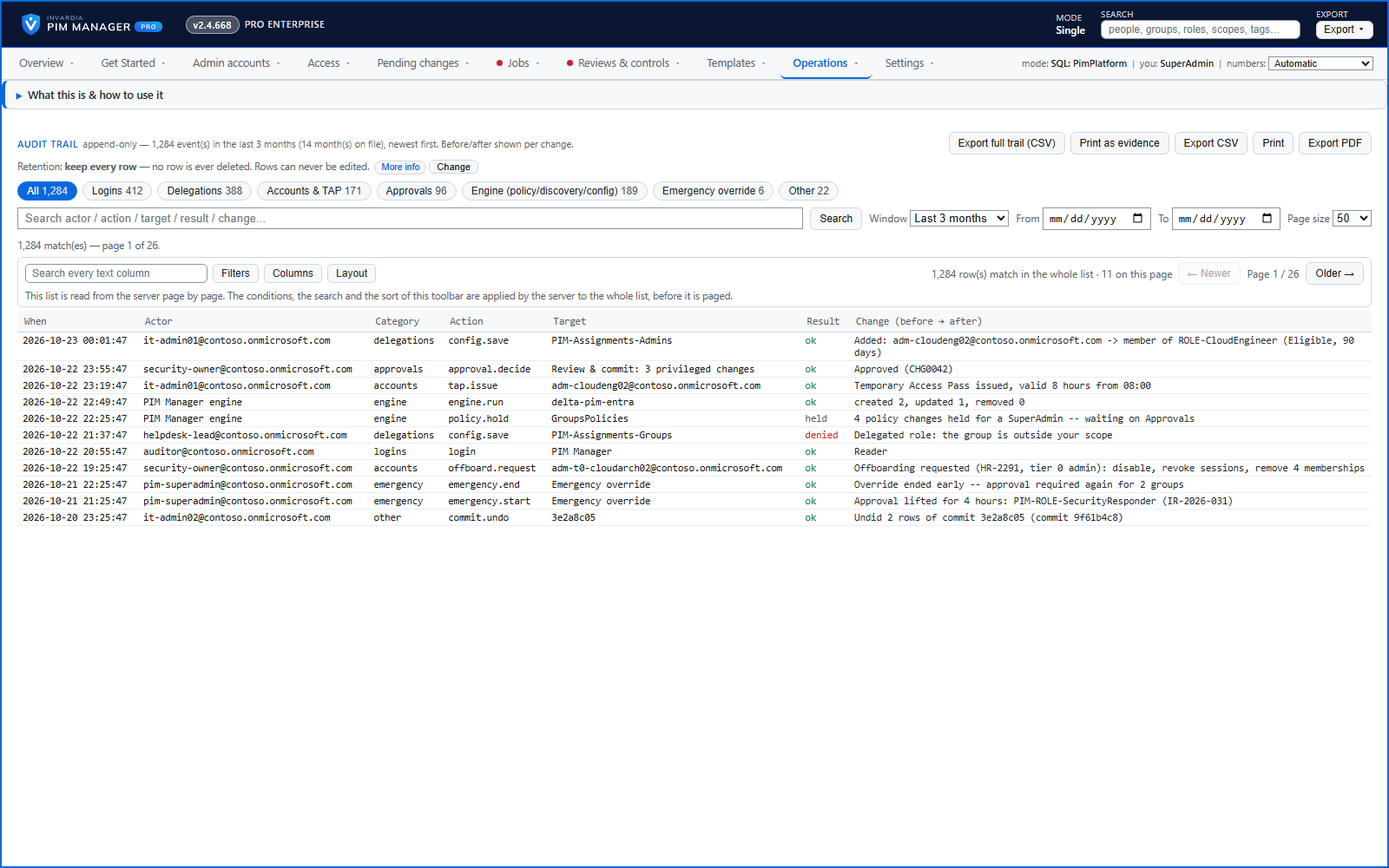
One audit trail, with before and after
Commits, approvals, setting changes, refusals and guard trips by the Manager and the engine in one append-only trail - who, what, when, the result, and the value before and after.
How it works →Tier impact report: who can reach Tier 0
The users with a path to Tier 0 or Tier 1 access - including through nested groups - sorted most-privileged first.
How it works →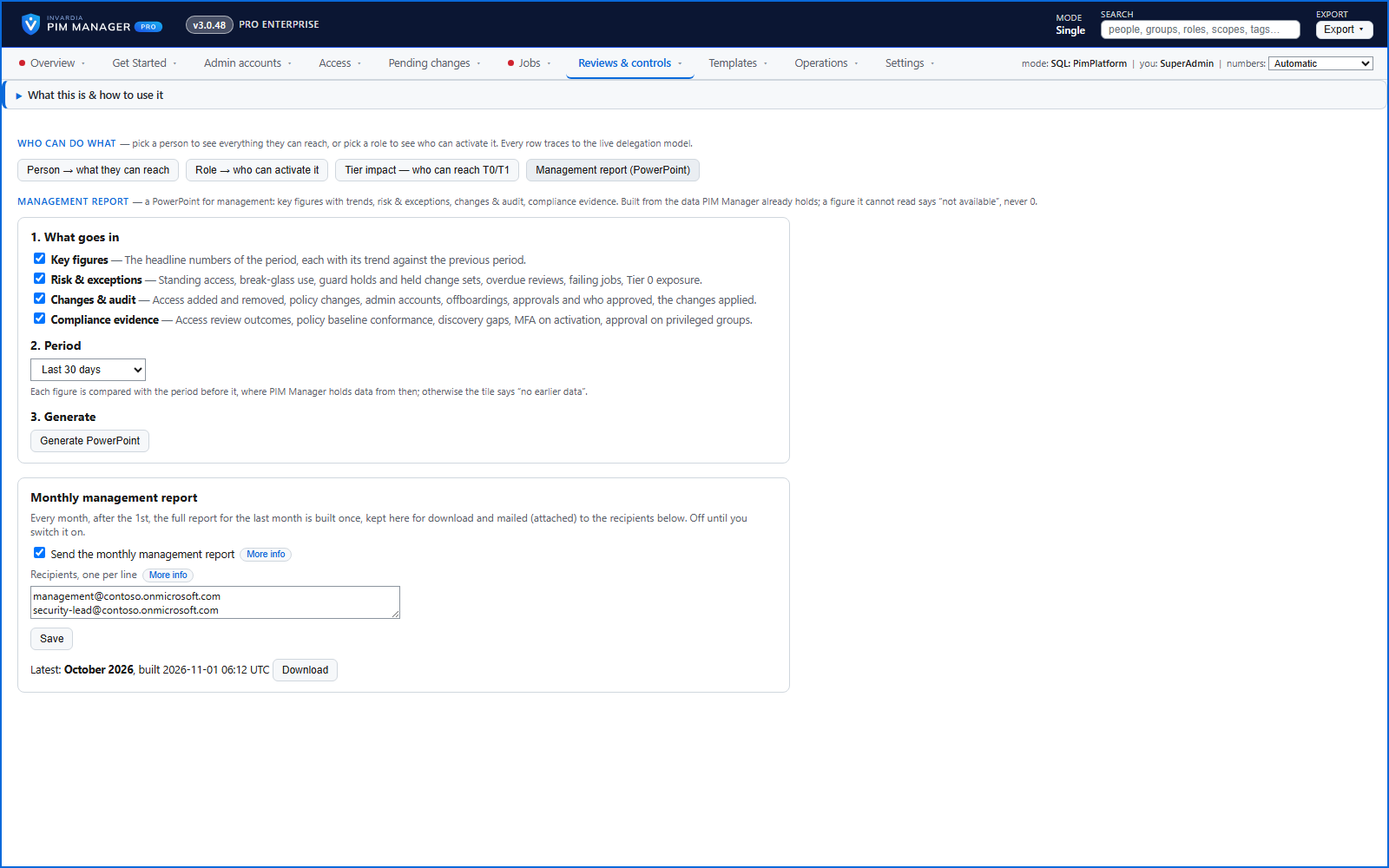
Management report: a PowerPoint for management
Under Reports > Management report you tick the sections, pick a period, and PIM Manager builds a PowerPoint in the PIM Manager look - on demand, or every month to the people you choose.
How it works →MSP: fleet conformance on one screen
A tenants by templates matrix shows which managed tenant is up to date, behind, not deployed yet or ahead - and plans the next rollout wave.
How it works →Save time
Wizards, ready-made permission packs, discovery and the PIM Activator replace hours of portal clicking - and the product installs with a guided command, checks itself and updates to signed releases.
PIM Activator: activate the access you need, together
A browser extension for Edge and Chrome: tick the groups and roles you need, give one justification and activate them together - three clicks for a typical activation.
How it works →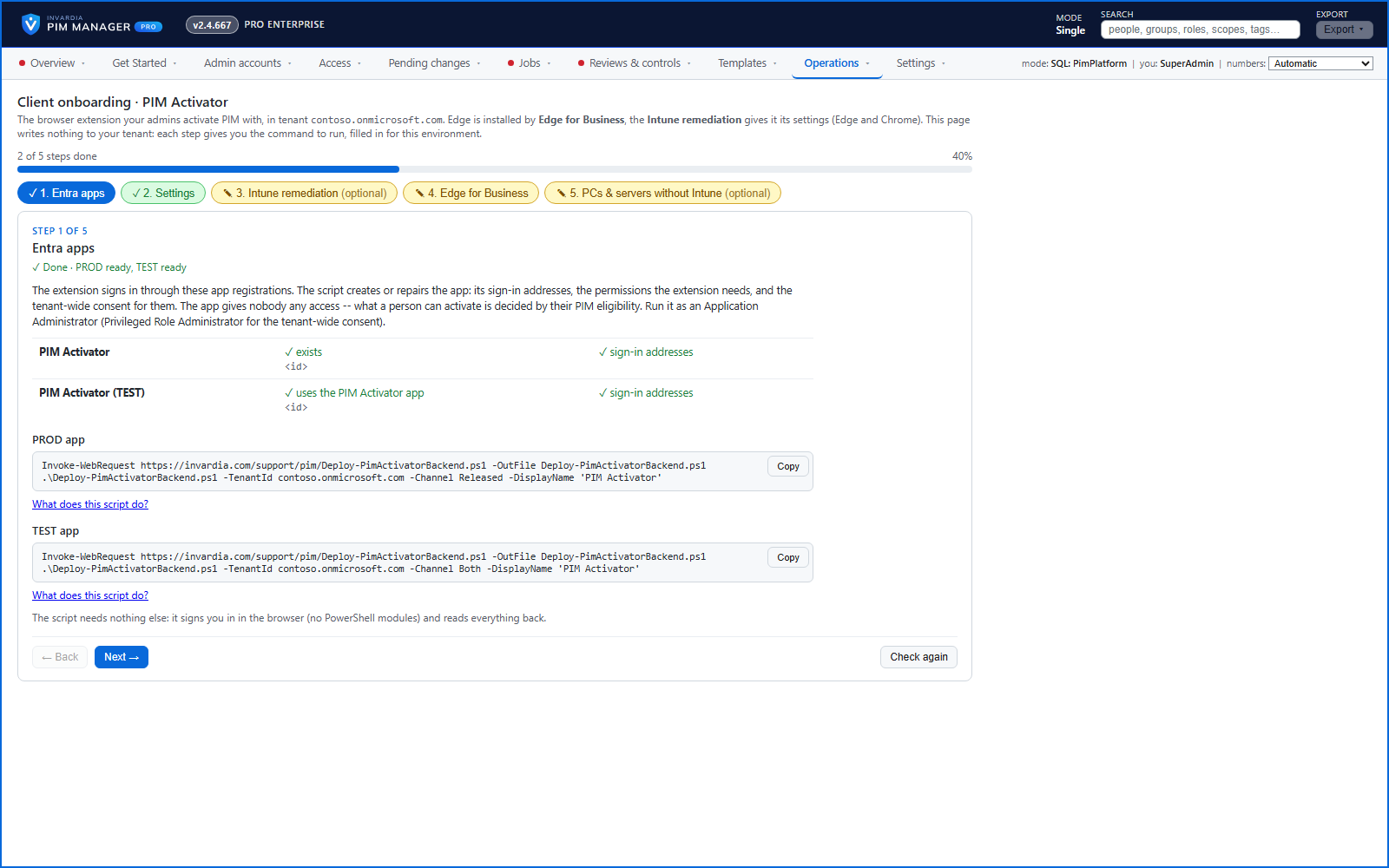
Roll out the PIM Activator from one guided page
One page takes you through deploying the browser extension: the sign-in apps, the settings, the Intune remediation, Edge for Business and PCs and servers without Intune.
How it works →An engine that keeps your tenant matching your model
You describe the access you want; the engine creates the groups, owners, policies, assignments and access passes your data defines, and keeps them that way.
How it works →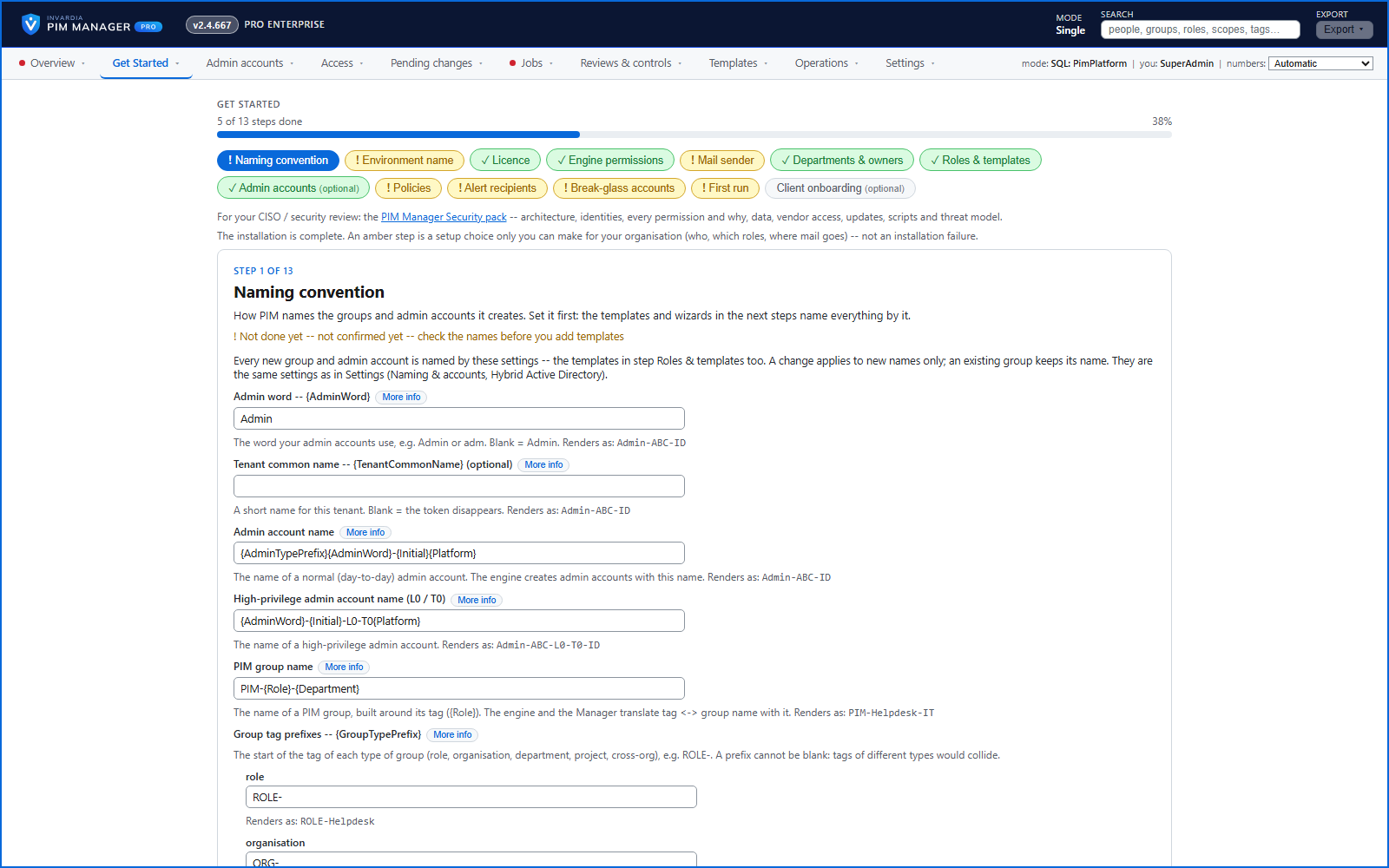
Get Started: the steps to a working environment
A guided list of the steps that make an environment work - each marked done or still open from your own data.
How it works →Admin accounts with the full lifecycle
Create admin accounts on a future date, hand over a first-time Temporary Access Pass safely, and disable them on an auto-disable date.
How it works →Access request portal: switch on an account, or get temporary group access
A disabled admin or consultant asks for their account back for a set time, or for short-term membership of a permission group you offer - approved, then switched off when the period ends.
How it works →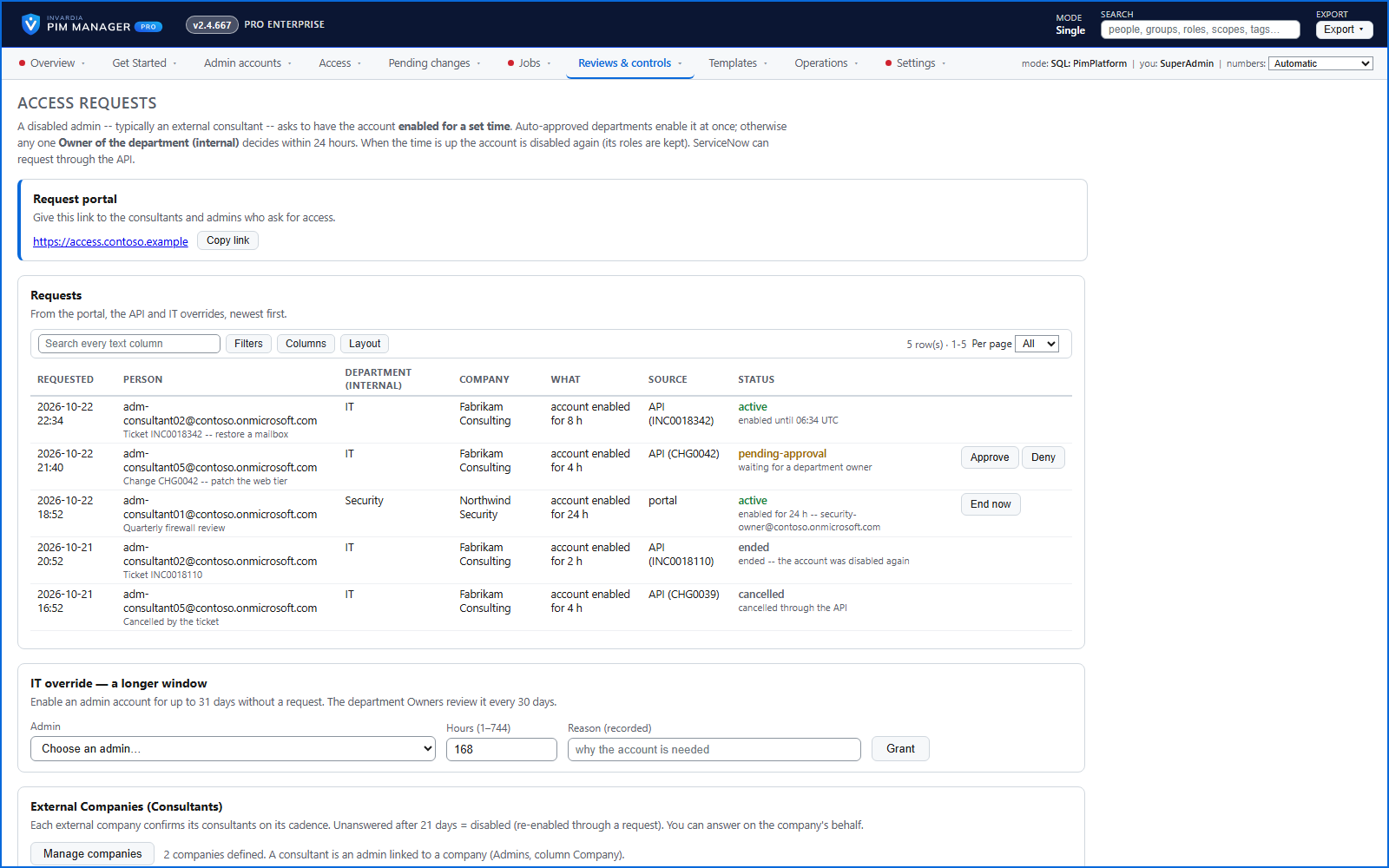
Let your ticketing system switch an admin account on for a set time
A REST API for systems such as ServiceNow: enable a disabled admin account or give a group membership for a period, read the status, cancel - or propose a change for an administrator to review.
How it works →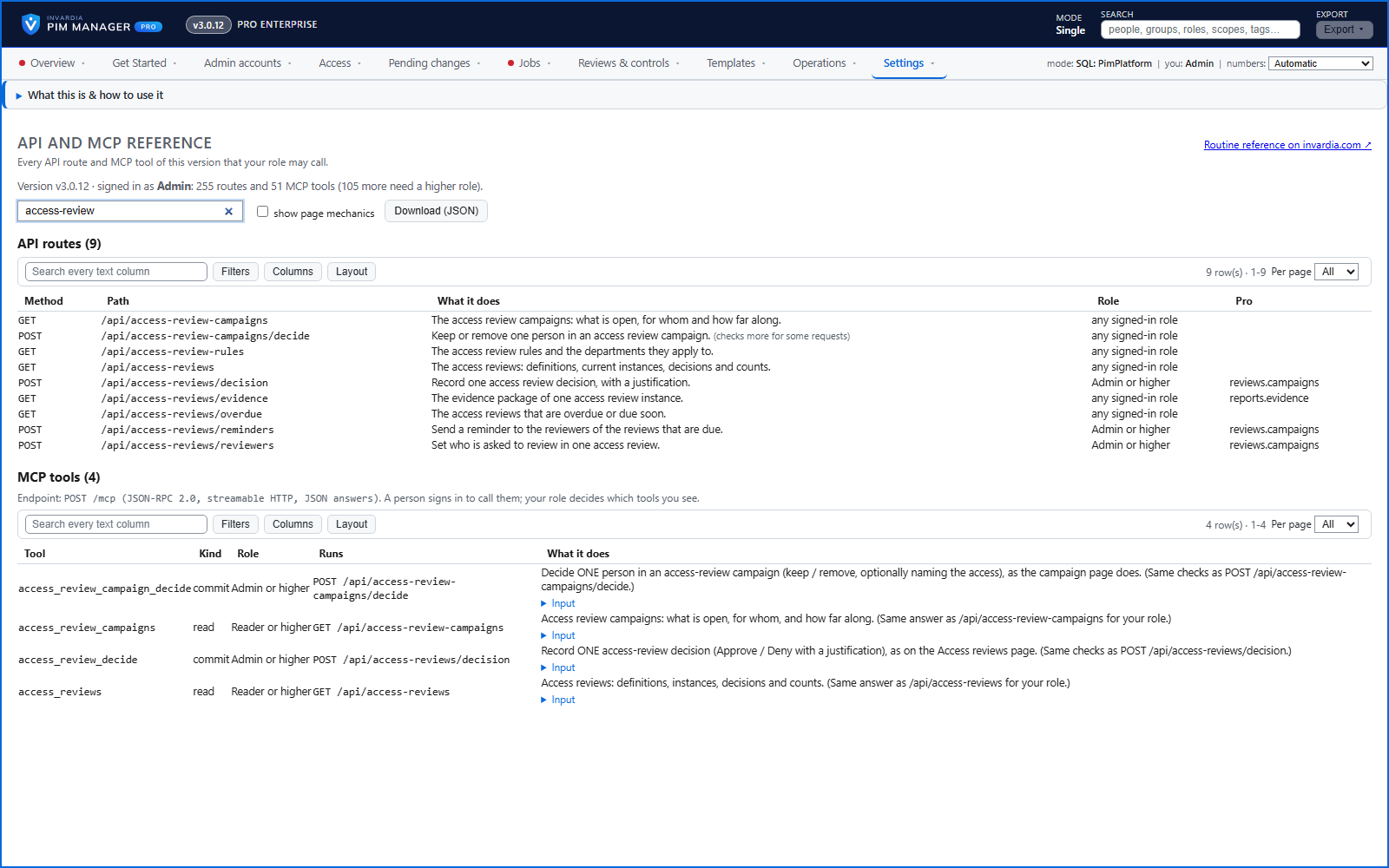
The API and MCP reference, inside the Manager
Settings > API and MCP reference shows every route and AI-assistant tool of the version you run that your own role may call, each with a plain description.
How it works →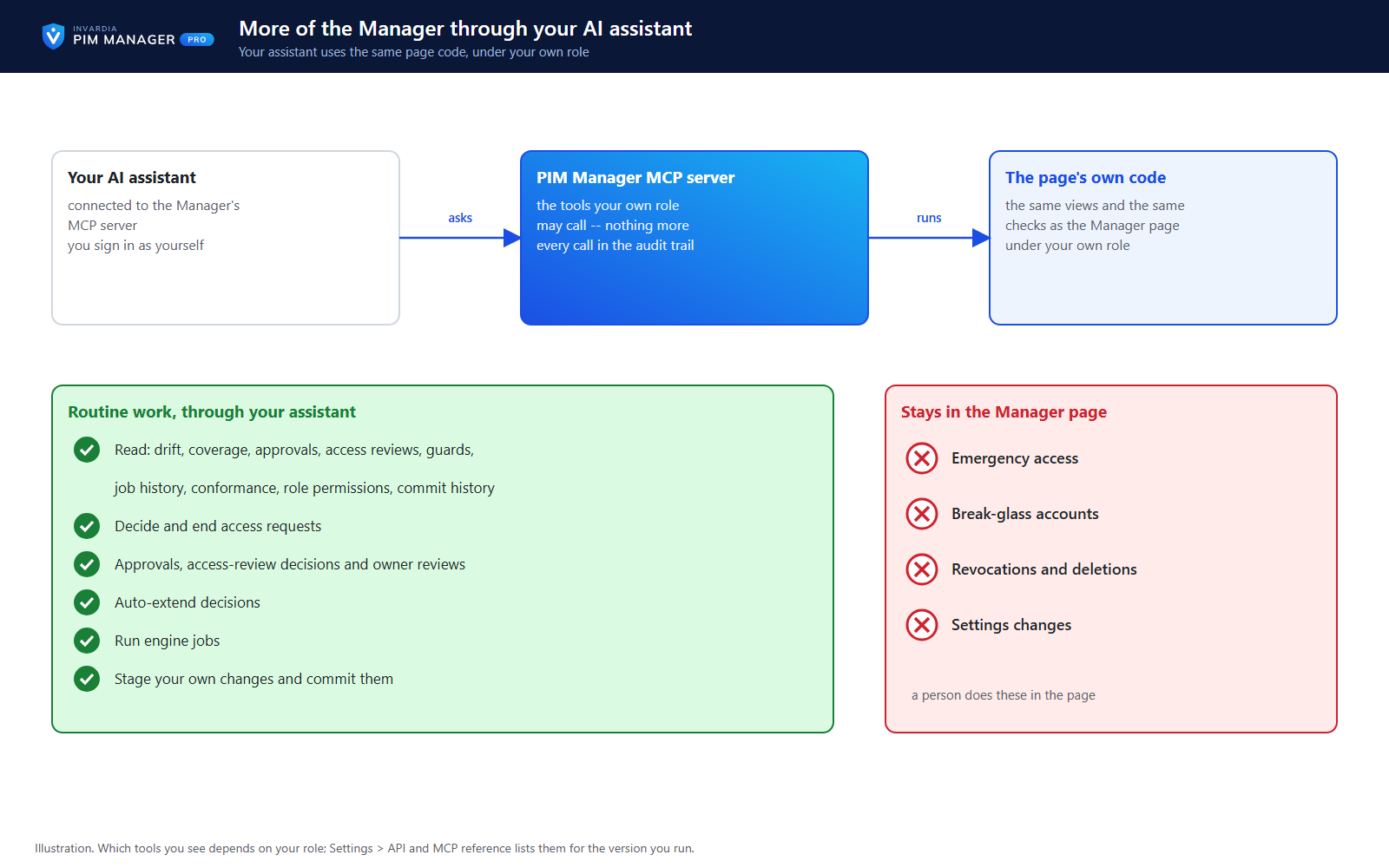
Routine work through your AI assistant
Your AI assistant reads every view of the Manager and does routine work - access requests, approvals, access reviews, owner reviews, auto-extend, jobs and staged changes - under your own role.
How it works →Invite external consultants straight into the delegation model
Invite a consultant as a guest and place them in a delegation group in one staged change; their owner can switch them on and off.
How it works →Discovery: new resources ready to delegate
New Azure subscriptions and management groups, Power BI workspaces, administrative units and new Entra ID, Intune and Defender XDR roles appear on Discovery and gaps - stage a proposal or ignore it.
How it works →More workloads: Power BI, enterprise apps, Azure DevOps, Dataverse and more
Grant the same groups Power BI workspace access, app roles in enterprise applications, and roles in Azure DevOps, Dataverse, Business Central and Power Platform.
How it works →Ready-made permission packs
Ready-made permission groups for Azure RBAC, Defender XDR, Entra ID, Exchange Online, Intune and Microsoft Sentinel - import the rows you tick. For Exchange Online and Sentinel the pack creates the groups; you give them their role there.
How it works →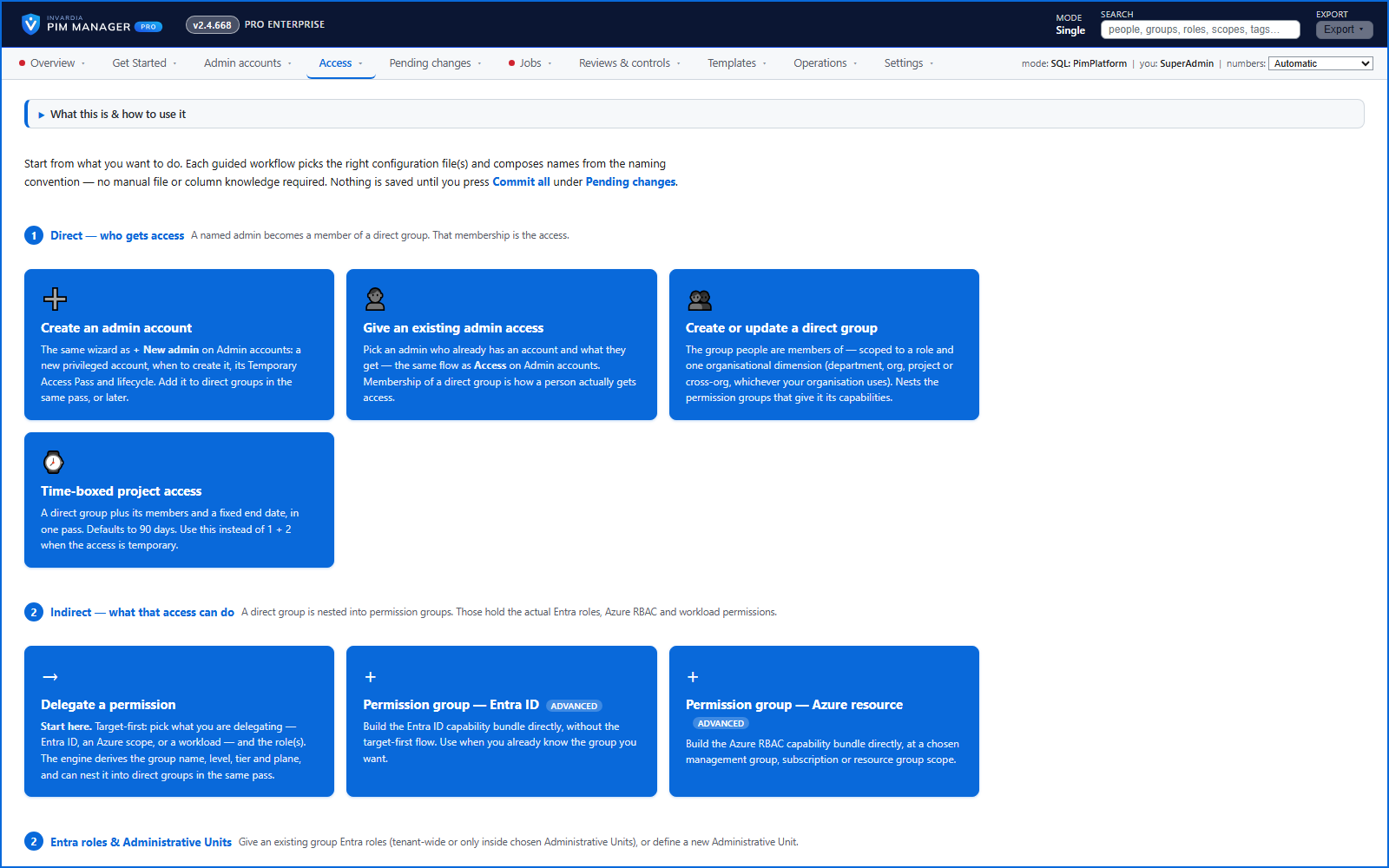
Create access the natural way round
Pick what you delegate, where, and which roles - the wizard works out the group, its name, level, tier and plane.
How it works →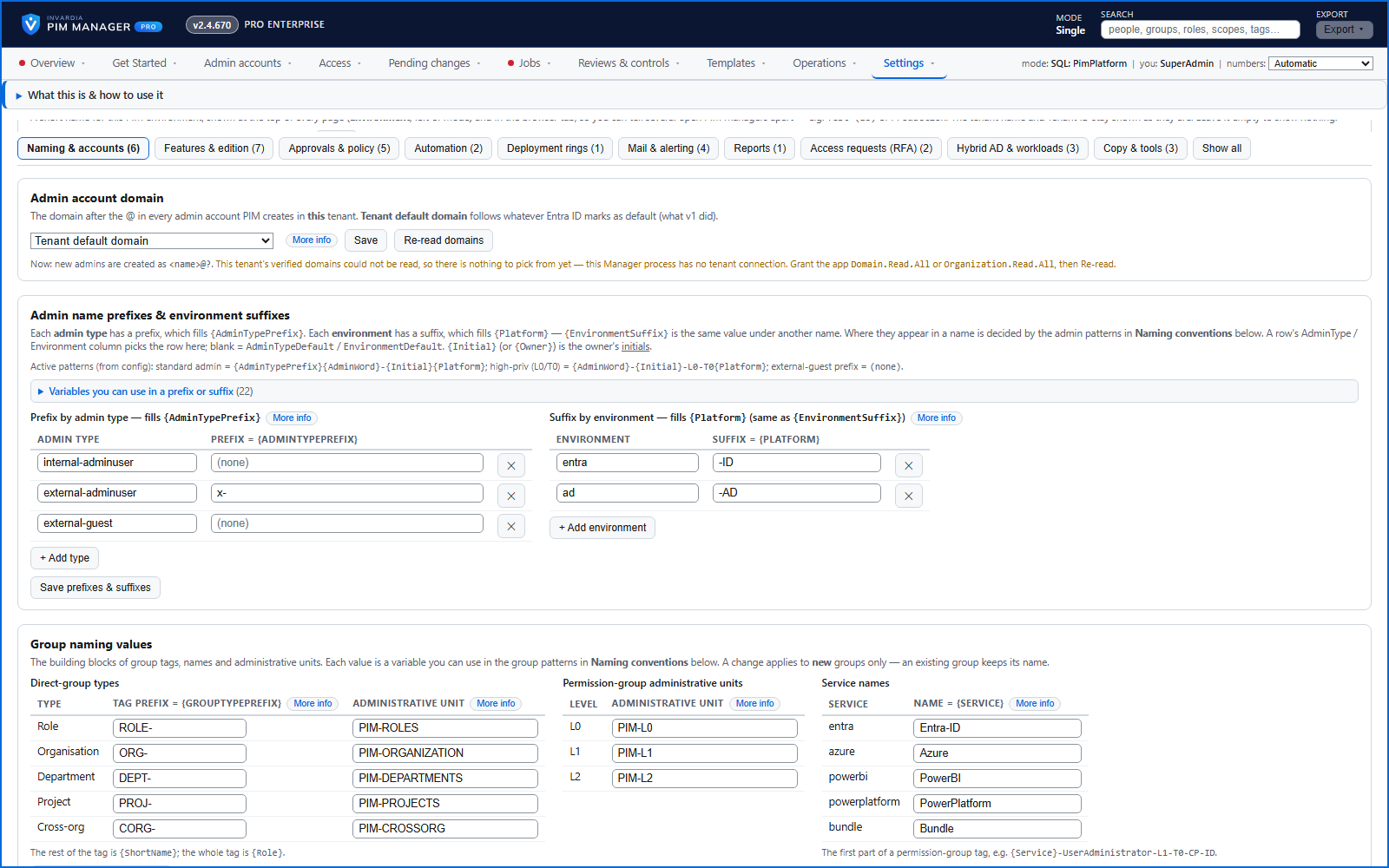
Naming that matches your organization
Admin, group and resource names follow patterns you set in Settings, with a preview of the names they produce.
How it works →Alerts by mail and Teams
A failed run, drift, access expiring soon and break-glass use - by mail, to a Microsoft Teams channel or to another https webhook.
How it works →Management report: a PowerPoint for management
Under Reports > Management report you tick the sections, pick a period, and PIM Manager builds a PowerPoint in the PIM Manager look - on demand, or every month to the people you choose.
How it works →Engine logs and errors, in plain words
Jobs, schedules and each run's log in the Manager; failures named in plain words - the group, the role and the scope - with what to do.
How it works →Switch capabilities on one at a time
Each optional capability has an on/off switch, advanced ones start off, and off means the engine and the scheduled jobs skip it.
How it works →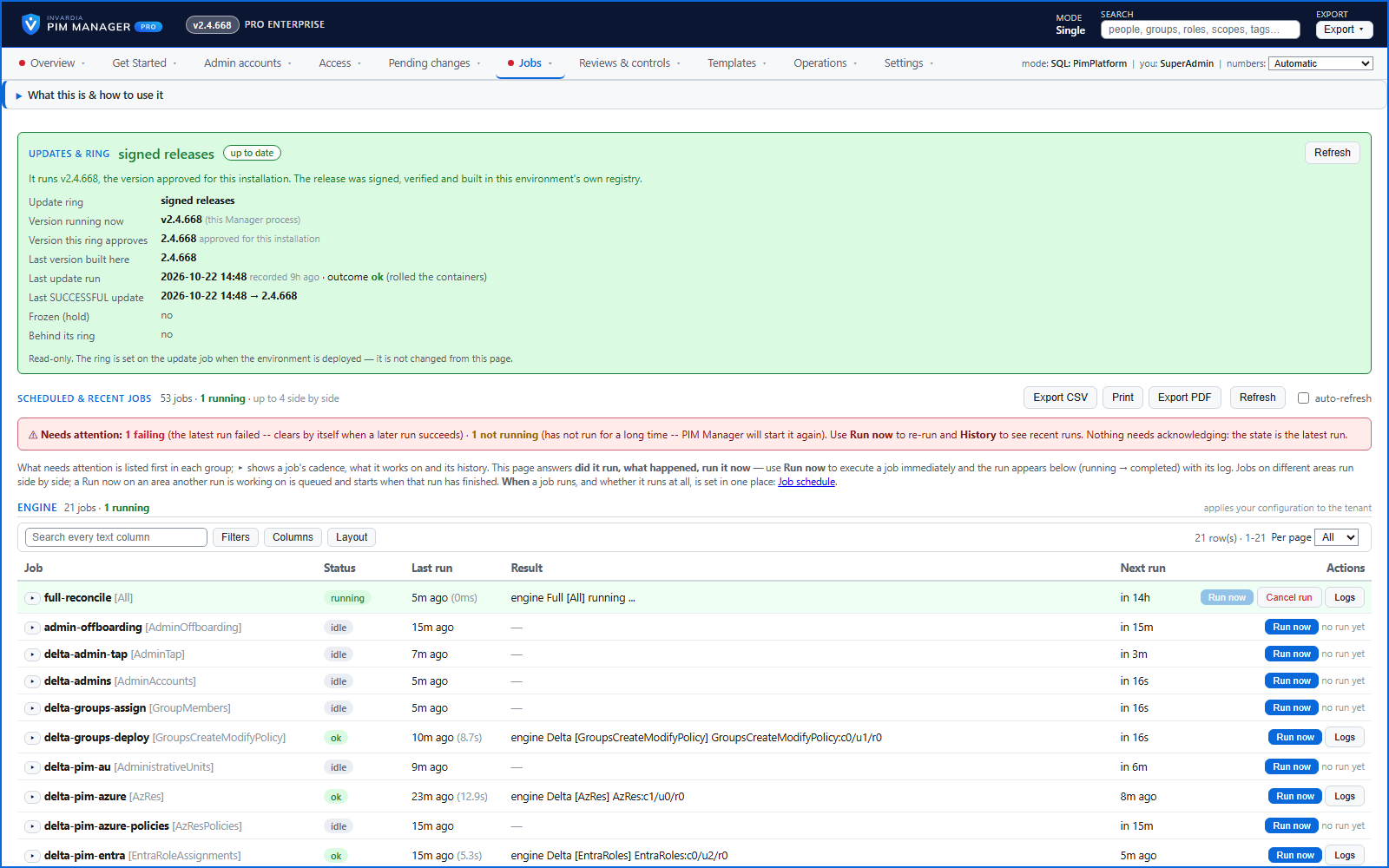
Signed updates, verified in your own subscription
Community and Pro installations update themselves each night, only to signed releases: built in your own registry, the database updated first, rolled back when a component is not healthy - under the controls you set.
How it works →A guided install that proves itself
A guided two-line install stands up hosting, database, identities and permissions, and sign-in - then reads every result back, and resumes from a failed step once you fix the cause.
How it works →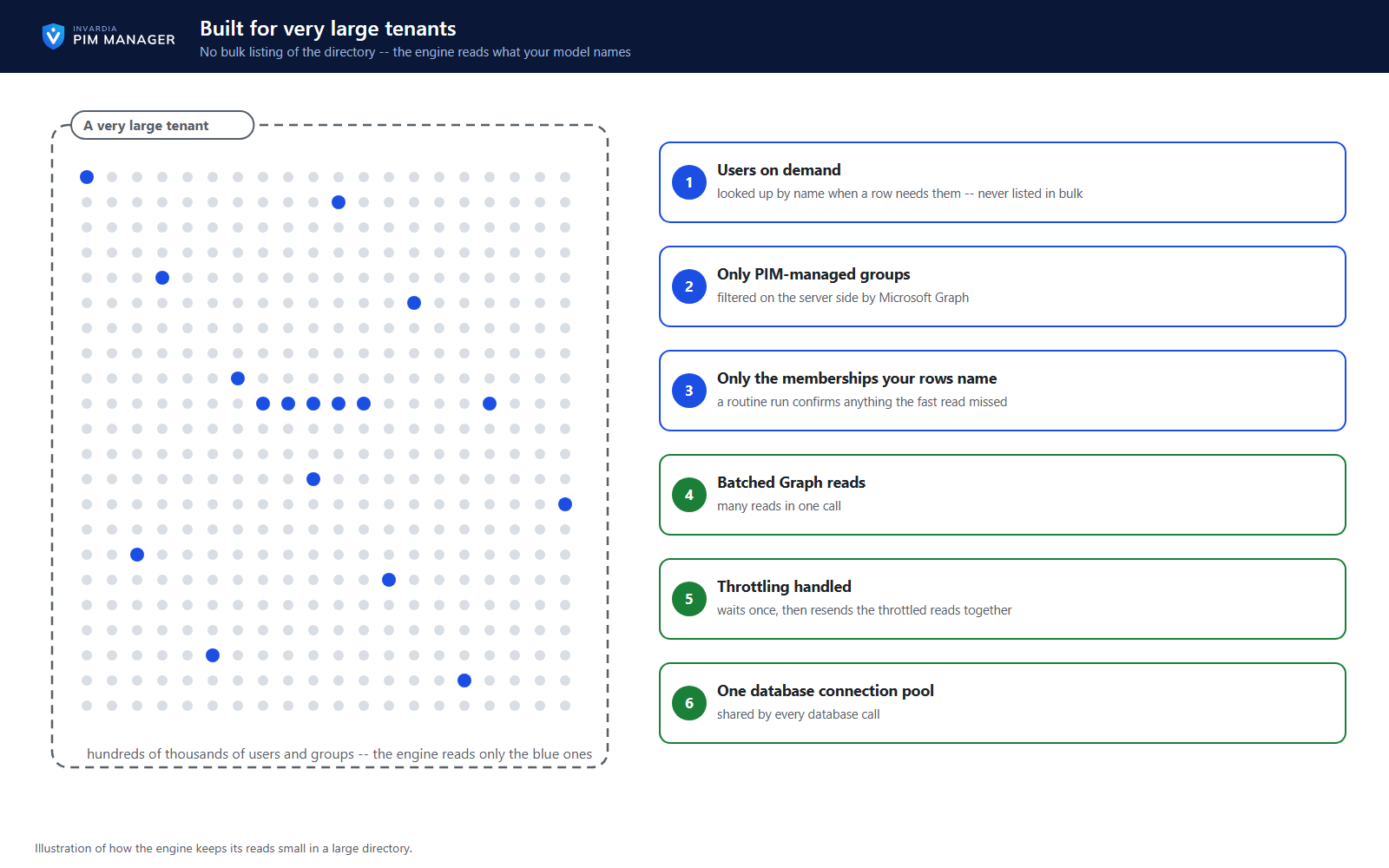
Built for very large tenants
No bulk listing of hundreds of thousands of users or groups: users are looked up on demand and only managed groups are read.
How it works →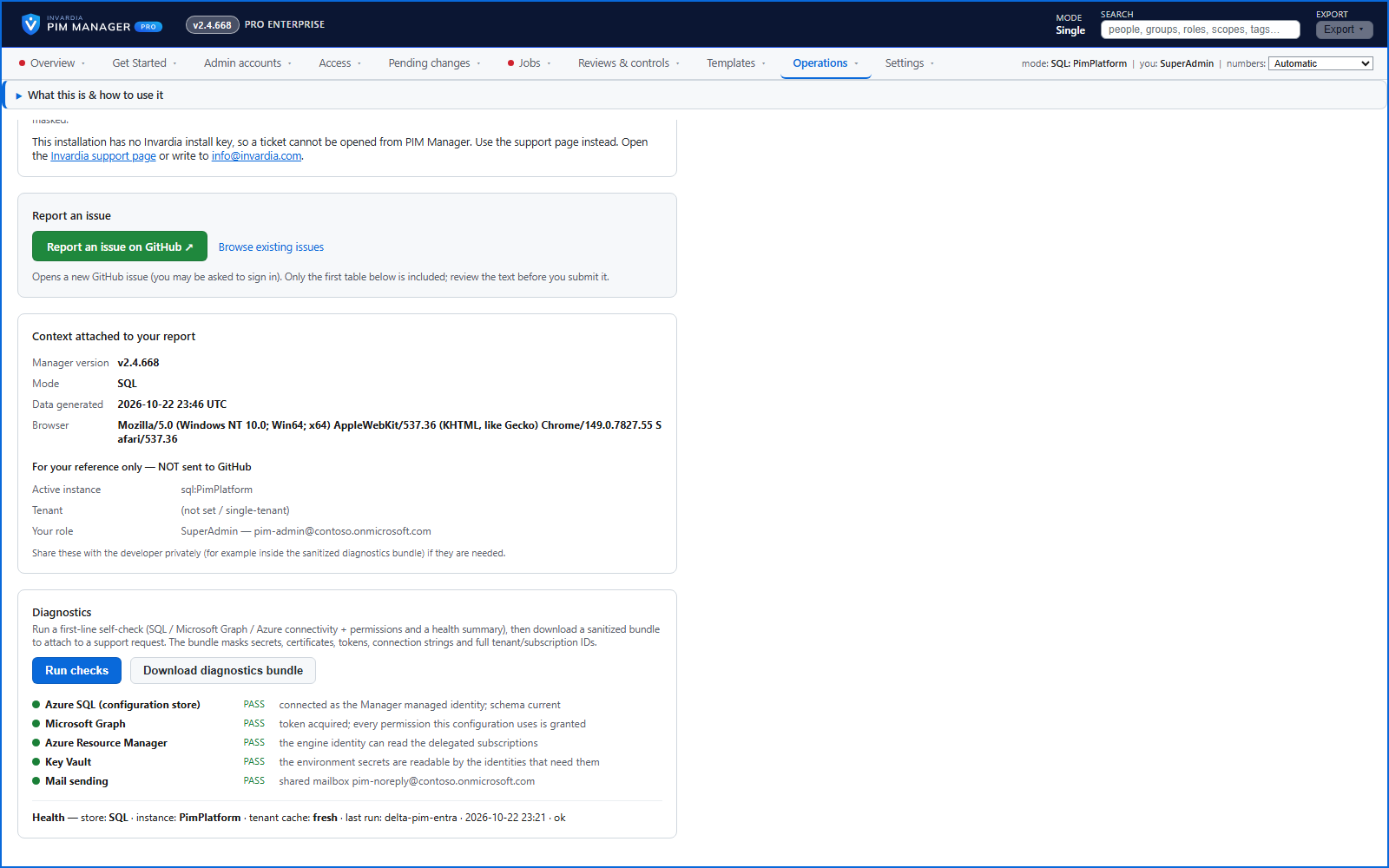
A self-check and a safe diagnostics bundle
Run checks tests the database, Microsoft Graph and Azure and explains each failure; the diagnostics bundle masks secrets before you share it.
How it works →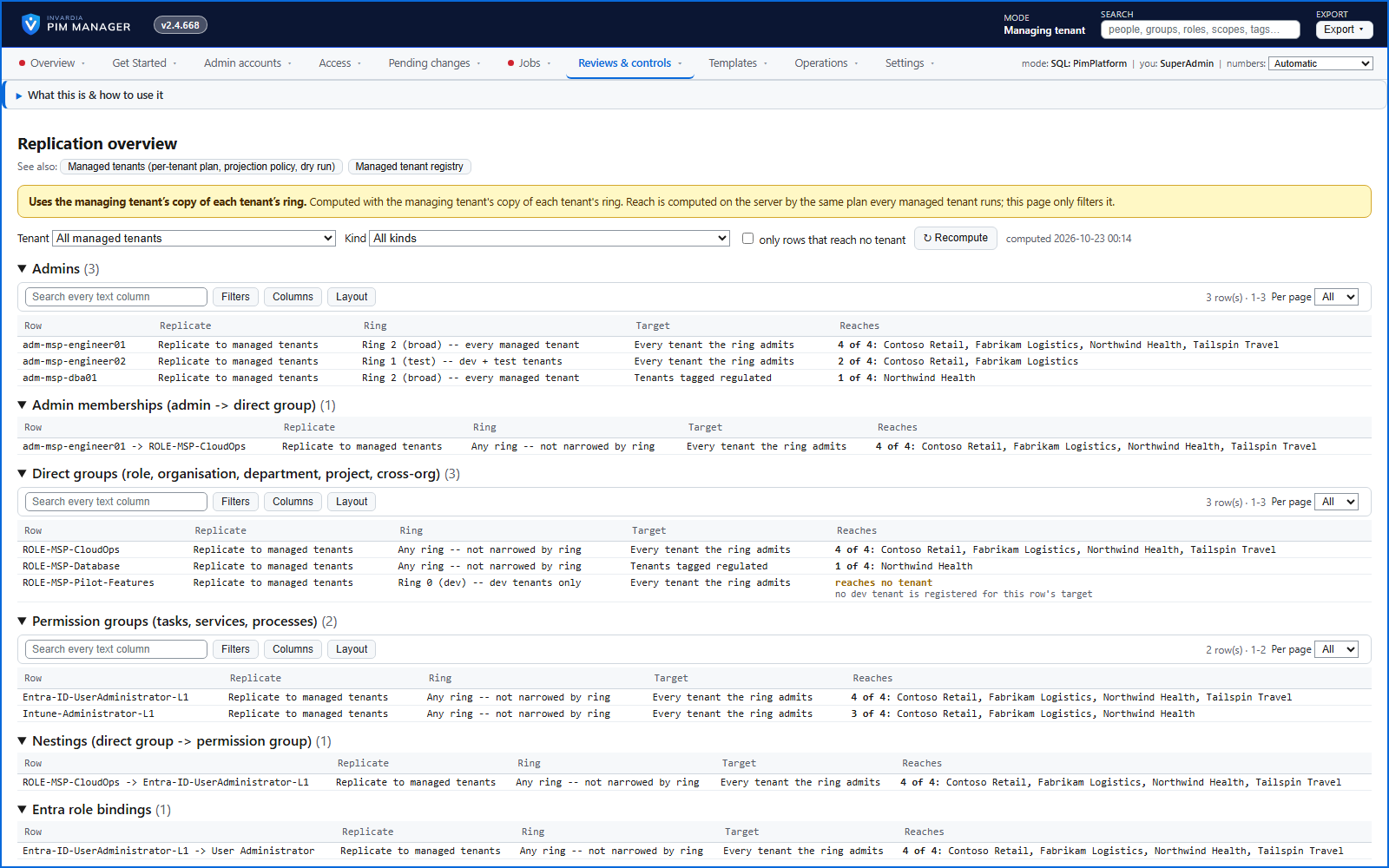
MSP: define once, roll out to your managed tenants
A provider defines admins and delegations once, and each managed tenant pulls a signed set into its own database - the managing tenant holds no rights in a managed tenant.
How it works →Secure by design
Runs in your own Azure on managed identities, with a portal identity that only reads your directory, a signed license bound to your tenant and signed updates you can verify.
PIM policy changes wait for a SuperAdmin
A policy run plans its changes and holds them until a SuperAdmin approves that exact change set, with the setting that weakens protection marked.
How it works →Changes only what you define - deleting an account is a person's decision
The engine changes groups, roles and admins only when your data defines them, does not disable, revoke or offboard your break-glass accounts, and does not delete a user account on its own.
How it works →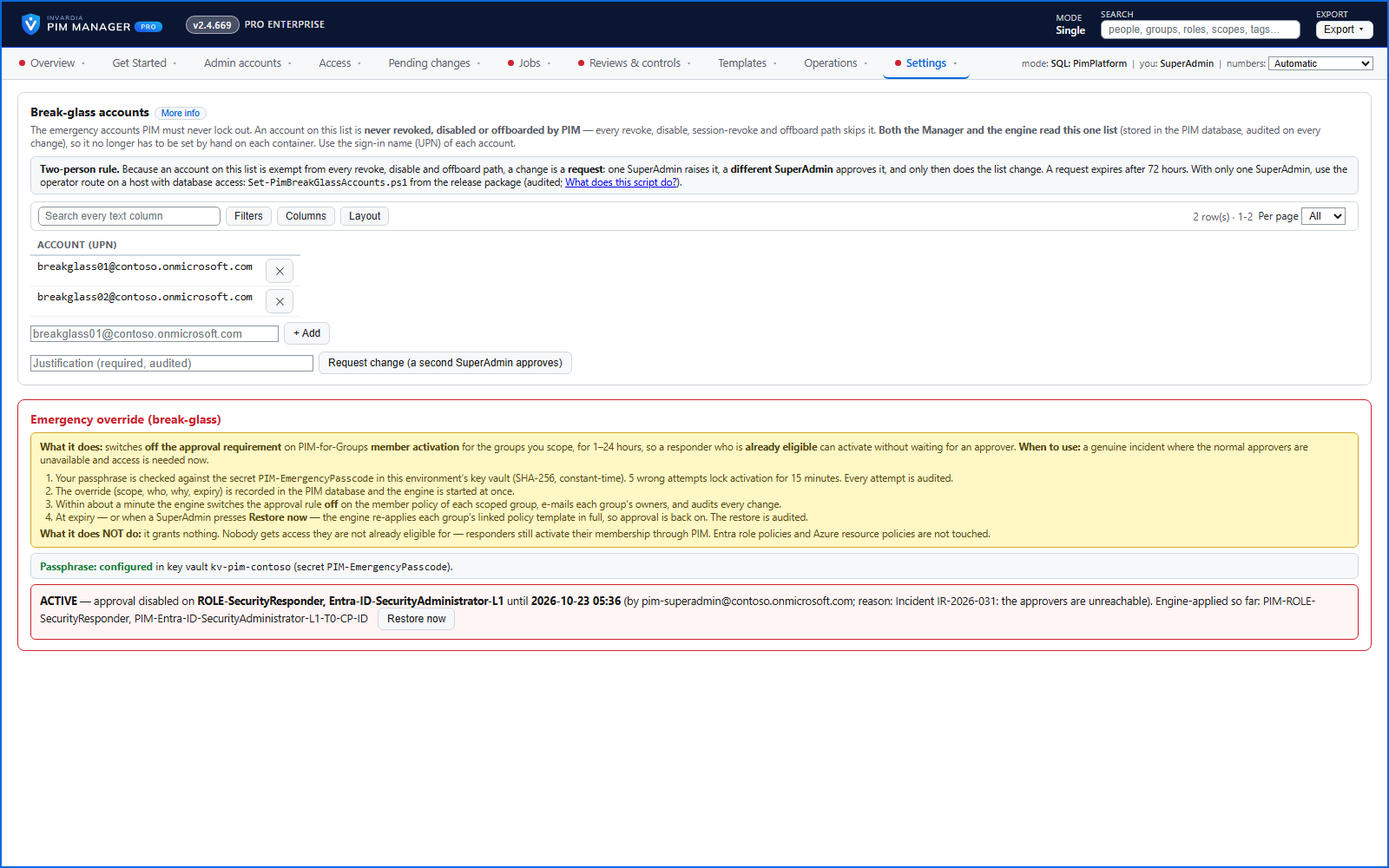
Emergency access: break-glass accounts and a time-boxed override
Your break-glass accounts are protected from PIM Manager's revoke, disable and offboard paths, and in an emergency a SuperAdmin can lift the approval requirement for a bounded time.
How it works →
Scripts and services on the Manager API, on your list only
Scripts and services use the Manager API only with an Entra application that a SuperAdmin lists and a second SuperAdmin approves, as Reader or Admin.
How it works →PIM for on-premises Active Directory
Just-in-time membership of on-premises AD groups, driven by PIM activation in the cloud and applied by a small hybrid worker.
How it works →Delegated administration of the Manager
Each identity is a Reader, Delegated, Admin or SuperAdmin in the Manager; a Delegated user, limited by tier, level, service or scope, sees and changes only what they own.
How it works →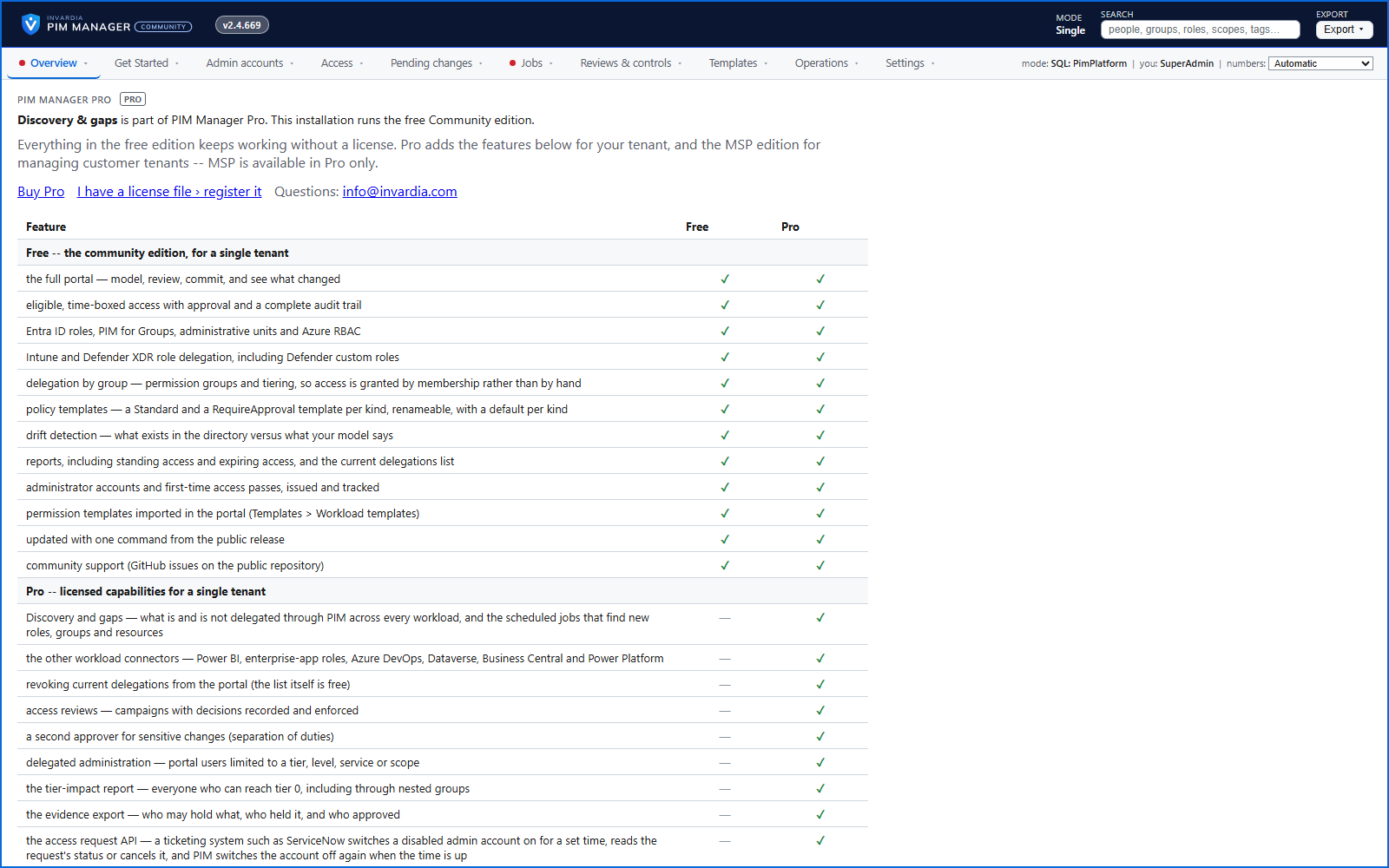
Community stays free - Pro is shown, not hidden
The Community edition is free for a single tenant and does not depend on a license; Pro capabilities are visible with the reason they are off.
How it works →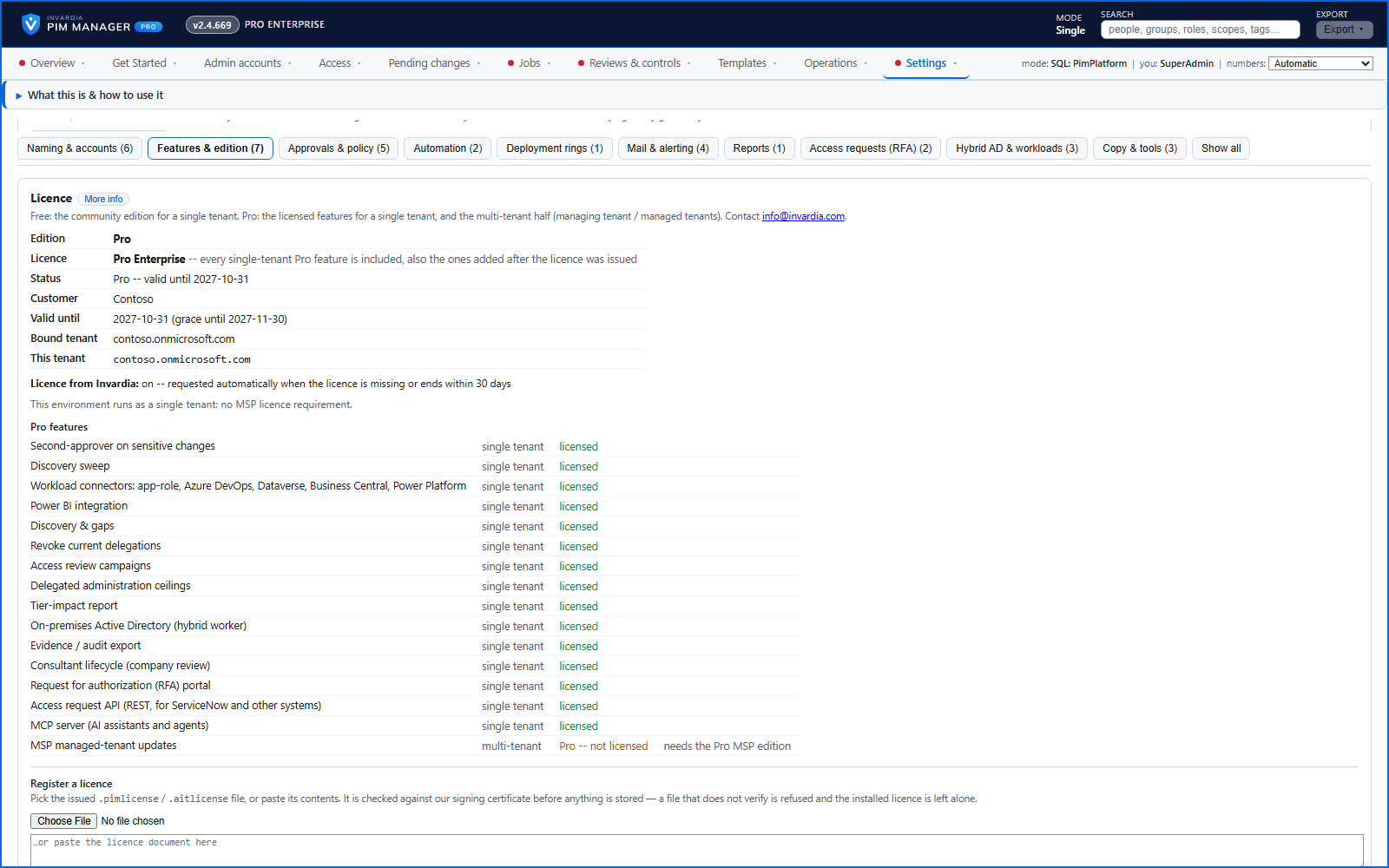
A signed license that works only in your tenant
The license is a signed document, checked offline and bound to the tenant it names - renewed through a request your installation proves.
How it works →Signed updates, verified in your own subscription
Community and Pro installations update themselves each night, only to signed releases: built in your own registry, the database updated first, rolled back when a component is not healthy - under the controls you set.
How it works →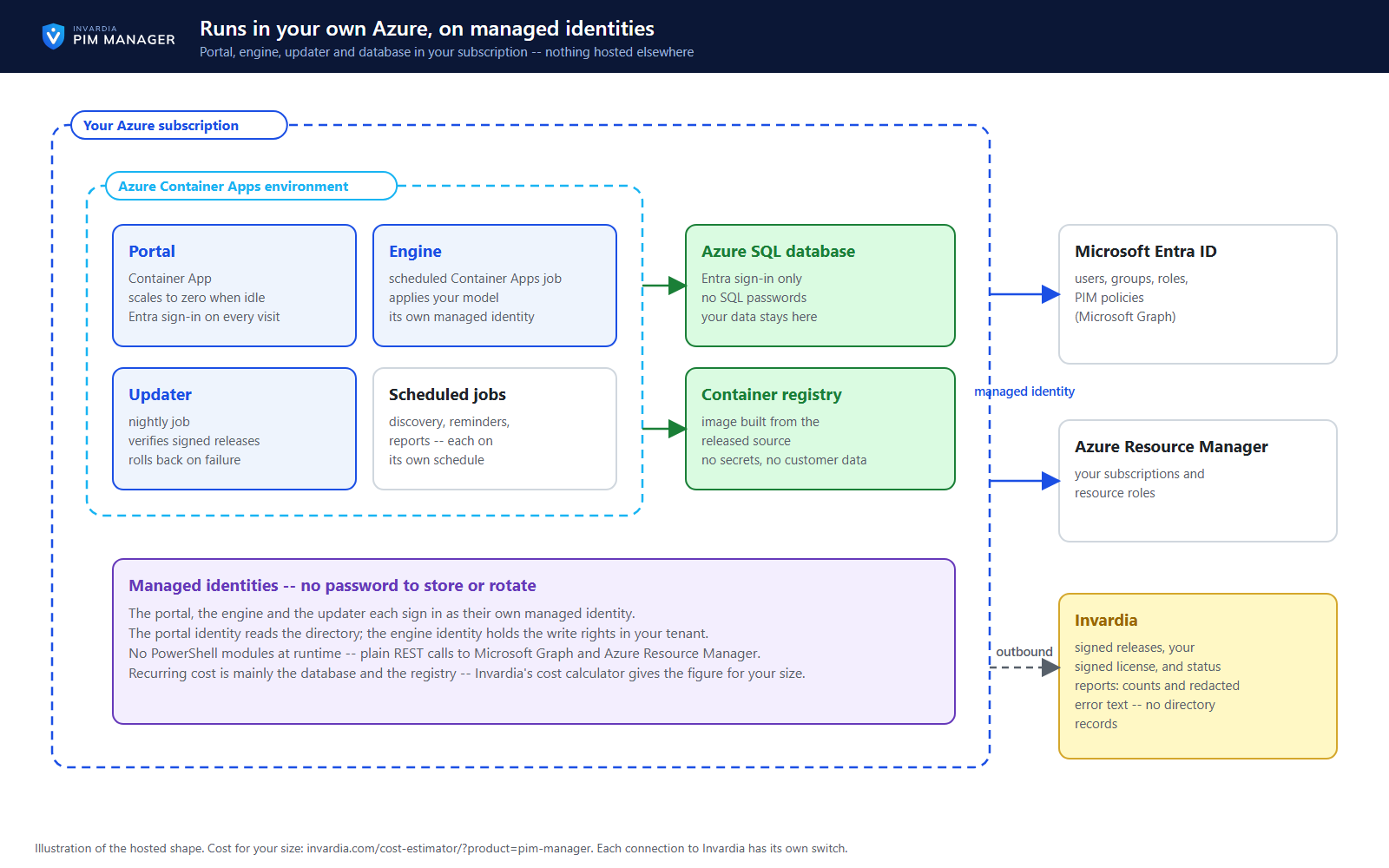
Runs in your own Azure, on managed identities
Manager, engine and database run in your own subscription on Azure Container Apps and Azure SQL - each component on its own managed identity, with no PowerShell modules.
How it works →A portal whose identity only reads your directory
The portal's identity has read-only directory permissions; changes are queued and carried out by the engine. Each visit requires Entra sign-in.
How it works →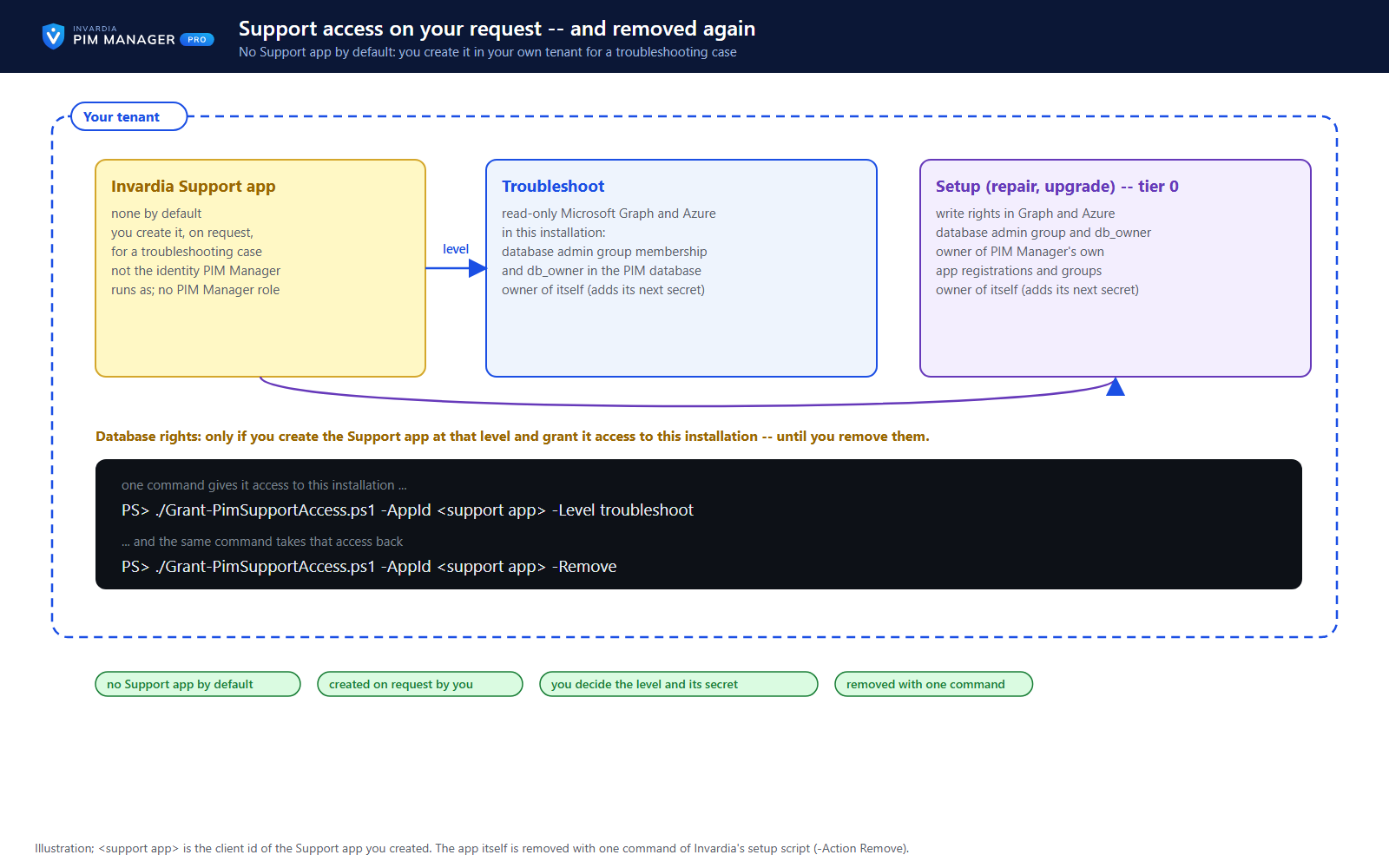
No vendor access by default - remote support only on your request
Invardia has no access to your installation by default. For a troubleshooting case you can create the Invardia Support app yourself, choose its level and its secret, and remove it when the case is done.
How it works →MSP: define once, roll out to your managed tenants
A provider defines admins and delegations once, and each managed tenant pulls a signed set into its own database - the managing tenant holds no rights in a managed tenant.
How it works →MSP: central admin accounts, removed across tenants at once
Provider admins flow down to the tenants that need them, with status and auto-disable date - and a leaver's access ends in the managed tenants on their next sync.
How it works →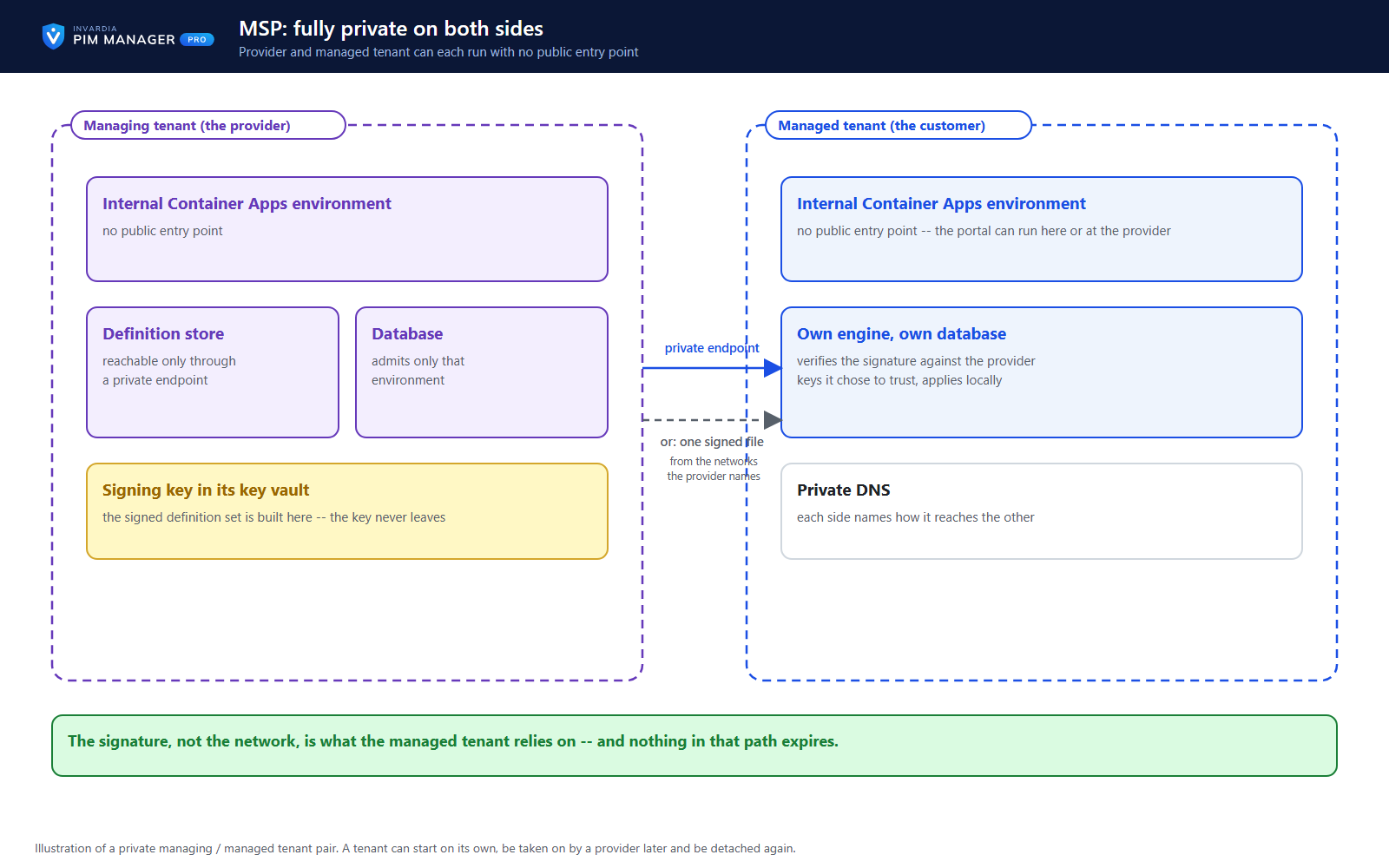
MSP: private on both sides, hosted where you choose
Provider and managed tenant can each run with no public entry point; the managed tenant's Manager can run in the provider's tenant or the customer's own.
How it works →Every feature, edition by edition
The Community edition is free for a single tenant: the full portal, the engine, Entra ID roles, PIM for Groups, administrative units, Azure RBAC, Intune and Defender XDR, and every Community feature keeps working without a license - including the second approver and the evidence export. Pro adds governance, access requests, more workloads, PIM for on-premises Active Directory and signed updates through Invardia; Pro Business has the same features for up to 5 managed admin accounts; Pro MSP adds the managing and managed tenants.


Community 72 features
Free, on GitHub:
See who can do what
- Access map: people, the groups they are in, what those groups include and the roles and scopes they grant
- Risk overlay for orphaned groups, unreached targets and unusually wide or Tier 0 / Tier 1 reach
- Reports: everything a person can reach, and everyone who can activate a role, with the exact path
- Role Lookup: what a role can do, roles ranked least-privileged first for an action, who can activate a role, two roles compared
- Delegation overview: active privileged access from a scheduled snapshot
- Home dashboard: failed jobs, findings, break-glass state, delegation by tier, gaps and expiring access
- Global search, CSV export and print on every view
Delegation model and coverage
- Two-tier group nesting: admins join role groups that nest into permission groups holding the roles
- Privilege tiers T0-T2 and levels L0-L9: access granted through group membership
- Entra ID roles (tenant-wide or in an administrative unit), PIM for Groups and Azure RBAC at any scope
- Intune roles for all devices and users (scope tags stay in Intune) and Defender XDR roles, including Defender custom roles end to end
- Every group gets an owner, resolved from the assignment, the sponsor or the department; groups and administrative units renamed in place
- Invite guest consultants straight into a delegation group, and let their owner switch them on and off
- Workload prerequisites checked and shown green, amber or red with the command to run
Policies and engine
- Standard and RequireApproval policy templates per kind, with a default per kind
- Activation policies changed only for the settings you chose, after a SuperAdmin approves the change set
- A RequireApproval template for delegations whose activation needs an approver
- Safety brake: every PIM policy change set waits for a SuperAdmin to approve that exact change set
- Touches only what you define; an account is deleted only when a person chooses Delete account
- Scheduled engine job; with the start right granted, a commit starts it at once
- Direct REST engine, no PowerShell modules; errors name the real object
- Only your PIM groups: other groups and their owners stay out of drift, alerts and pages
Change safely
- One Pending changes queue for configuration edits, revokes, pass re-issues and session revokes
- Every commit backs up the stored model first and saves it all-or-nothing; undo a commit by committing its inverse or restore from Backups. Removed live access and a deleted account cannot be undone
- Drift, live versus desired: Apply now or Ignore for missing and changed items; Import into PIM, Delete or Ignore for extras; Re-add for an ignored finding
- Target-first create-access wizard, bulk-attach, clone, administrative-unit wizard and admin bulk import, each previewed
- Ready-made permission packs for Azure RBAC, Defender XDR, Entra ID roles, Intune, and the permission groups for Exchange Online and Microsoft Sentinel
- Capabilities switched on one at a time; off means off everywhere
Lifecycle, safety and audit
- Admin accounts created on a future date, with one Temporary Access Pass mailed to the admin's office address or the sponsor department's owners
- Auto-disable date: disables the account on its date and keeps it; with Automatic offboarding on (off by default) it also revokes sessions and removes memberships in the groups PIM Manager defines
- Unmanaged admin accounts listed with Import or Ignore
- Emergency break-glass override: passphrase-gated, time-boxed, audited
- One audit trail with before and after values, append-only for PIM Manager and the engine, optional copy to Log Analytics, with the full export
- Daily checks for delegations pointing at Azure resources or roles that no longer exist, and for changes staged but not committed
Notifications
- Alerts by mail, to a Microsoft Teams channel or to another https webhook, with a feed that proves delivery
- The same condition mailed once, then at most once a day
- Template-driven mail, editable in the portal, with a kill switch, redirect and allowlist
PIM Activator browser extension (Edge and Chrome)
- Bulk activation with one justification, and a confirm step for large selections
- See what a group grants before you activate it; done only when the access is really there
- Sub-groups activated as they appear; waiting for approval shown as such
- Deploy to managed devices with Intune or browser policy, with tenant-wide defaults
- Roll it out from one guided page: sign-in apps, settings, Intune remediation, Edge for Business, and PCs and servers without Intune
Hosting, setup and security
- Installs into your own Azure subscription with a two-line command; a final check reads every result back, and a failed step resumes once you fix the cause
- Portal on Azure Container Apps (scales to zero), a scheduled engine job and Azure SQL with Entra-only sign-in
- Managed identities; PIM Manager's identity has read-only Microsoft Graph permissions and the engine holds the write rights
- Entra sign-in required for each request; name who may open the portal; private-only deployment supported
- No sign-in secret left behind: once the sign-in front is live, the old sign-in secret is removed and checked
- Reader, Admin and SuperAdmin roles, failing closed to read-only
- A second approver for sensitive changes (separation of duties), off by default
- The evidence export: who may hold what, who held it, who approved
- Support page: a connectivity and permission self-check and a diagnostics bundle with secrets masked
- Updates itself each night to signed releases from Invardia's Community channel, checked and built in your own registry; or by one command you run, with the same checks
- Get Started: every step to a working environment, marked done or open from your own data
Not in Community: single tenant (Pro Business / Enterprise)
- Discovery and gaps: what is and is not delegated through PIM across every workload, and the scheduled jobs that find new roles, groups and resources
- The other workload connectors: Power BI, enterprise-app roles, Azure DevOps, Dataverse, Business Central, Power Platform (Community has Entra roles, PIM for Groups, AUs, Azure RBAC, Intune, Defender XDR)
- Revoking current delegations from the portal (the list itself is free)
- Access reviews: campaigns with decisions recorded and enforced
- Delegated administration: portal users limited to a tier, level, service or scope
- The tier-impact report: everyone who can reach tier 0, including through nested groups
- The management report: a PowerPoint for management, on demand or monthly
- The access request API: a ticketing system (e.g. ServiceNow) switches a disabled admin on for a set time; PIM switches it off again
- PIM for on-premises Active Directory: AD admin accounts, PIM groups mirrored to AD groups, just-in-time AD membership (hybrid worker)
- the AI assistant (MCP), API applications for scripts and services, and the API and MCP reference
- Support from Invardia with an agreed response time (Community: GitHub issues)
Not in Community: multi-tenant (Pro MSP)
- Define once, target many: tenants by tag and rollout wave
- Signed definition sets, verified on arrival
- What reaches each tenant and what is held back; per-customer rules
- Read-only preview of what a tenant would receive
- Fleet conformance; rollout waves; release rings for the software
- Central accounts whose lifecycle flows down; removals stay the tenant's call
- The provider-hosted option (provider runs portal + database)
- A managing or managed tenant requires Pro; without it, the publishing and downlink jobs refuse to run


Pro Enterprise 21 features
Everything in Community, plus:
Governance
- Access reviews per department: Keep or Remove, one or two approvers, reminders, enforced by the engine
- Tier-impact report: everyone who can reach Tier 0 or Tier 1, including through nested groups
- Management report: a PowerPoint with key figures and trends, risk and exceptions, changes and audit, and compliance evidence; on demand, or monthly to the recipients you list
- Revoke current delegations from Delegation overview, with a preview, protected break-glass accounts and, with Approval-gated offboarding + revoke on, approval for large batches
- Delegated administration: portal users limited by tier, level, service or scope
Access requests and consultants
- Access request portal: a disabled admin or consultant signs in with a one-time PIN and asks for the account for a set time
- Ad-hoc group access: short-term membership of an offered permission group, removed automatically
- Access request API for ticketing systems such as ServiceNow: enable an account for a period, read the status, cancel, or propose a change
- External companies confirm their consultants on a cadence; a consultant reported as a leaver, or not confirmed within 21 days, is disabled
Find what is missing
- Coverage and gaps across Entra ID, Intune, Defender XDR, Power BI, Azure and PIM for Groups, with ready proposals
- Discovery inbox: new Azure scopes, Power BI workspaces, administrative units and roles - stage the proposal or ignore it
More workloads
- Power BI workspace delegation
- App roles in any enterprise application - gallery apps such as SAP, ServiceNow or Salesforce, or your own
- Azure DevOps, Dataverse / Dynamics 365, Business Central and Power Platform
- PIM for on-premises Active Directory: AD groups mirrored from PIM groups and just-in-time AD membership, applied by a small hybrid worker with one managed service account per tier and your own naming
License, updates and support
- Signed license, checked offline and bound to your tenant; with license requests on (the default), it arrives and renews by itself
- Signed updates through Invardia: verified, built in your own registry, never applied under a running PIM job, rolled back on failure; you can hold, reschedule or switch them off
- A new Pro installation updates itself from day one
- From Community to Pro without reinstalling
- Support by mail or at portal.invardia.com; Invardia has no access to your installation unless you create the Invardia Support app for a case and remove it afterwards
- Support's database access follows your consent: a read-only database user, and admin rights only inside an open support session - the database owner role for at most 8 hours and a time-limited database admin group membership of at most 24 hours - that end by themselves
Pro MSP 20 features
Everything in Pro Enterprise, plus:
Define once, target many
- Signed definition sets built daily and on demand; the signing key is non-exportable in the provider's Key Vault
- Each managed tenant chooses which provider keys it trusts and verifies every set before applying it
- Pull, not push: the provider holds no rights in a managed tenant; each managed tenant applies the set with its own identity and keeps its own database
- A pull that finds nothing changed stops without applying anything
- Copy a setting from one tenant to another, backing up the target first
Roll out safely
- Rollout waves for managed tenants (three by default, up to ten, renameable), with tag rules per wave
- A row the wave does not admit is withheld, not retracted: the tenant does not receive it, and what it already holds stays untouched
- Preview per row and per tenant of what arrives and what is withheld, with the reason
- Fleet conformance: a tenants by templates matrix and a wave-by-wave rollout planner
- Managed tenants page and a replication overview
Central accounts
- Provider admins synced by their own record, by tags, or only where a replicated delegation names them
- Status and auto-disable date flow down to the managed tenants
- Revoke a person's sessions in the managed tenants too: each tenant revokes them on its next pull and checks the result
- Signed central kill: disable or revoke an account across all tenants
- Remove an admin in all, some or none of the managed tenants
- A Source column on every managed-tenant record: from the managing tenant, or local
Hosting
- Provider-hosted, or hosted in the customer's own tenant
- Fully private networking on both sides, or a read of the one signed file from the networks the managing tenant names
- Build the managing and managed tenants with one script and one configuration file, with a plan first
- The header shows each tenant's mode: single tenant, managing tenant or managed tenant